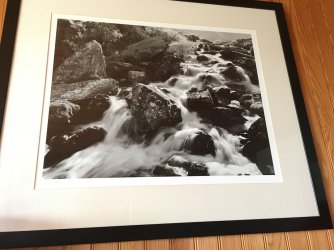
I do think that cameras like the Nikon D810 have incredible ability to pull detail back especially in the shadows, however, no better than film that's been correctly developed to match the scenes DR, and keep in mind the film process goes back over 100 years, yes its that good.
Just as film has to be carefully exposed and developed to optimise its DR, so does a digital camera image. Both Helen and I have found it is only too easy to slip into "snapping" mode with a DSLR. However, with a DSLR, when you take the time to evaluate the scene in front of you, spot measure the highlights and shadows, calculate the DR and position the exposure correctly within the DR, you will get every bit as good results as with film.
However, if you "snap" the picture, with the intention of "fixing" it later in post processing software, then you are unlikely to get the same quality of results. As far as I can remember, Ansel Adams said something along the lines of "garbage in - garbage out" when it comes to printing a negative.
I think the question of which looks best in print Digital or Film has a big question mark, firstly, if you use film to capture images then scan them on to a computer, that file is now digital, the output to the printer is digital, it's all dots of ink, unlike the Silver Halide print which is continuous tone, the nearest prints I have seen to compare with the darkroom are indeed the laser Lambda printers, which transfer the image onto Silver Halide papers and thereafter is a chemical process, expensive if you do a lot of printing, great for the one off large print.
And there is the key to the whole argument. It's not just about comparing a silver halide print to a digital print. As I've said before, I very much doubt if you could tell the difference between a well processed digital image, output to silver halide paper via a lambda printer, and a "traditional" darkroom print.
Can I tell a difference between and digital print or a scanned print, yes I can, they have a more textural quality, a more "film look", they don't look falsely sharp, but it's not chalked and cheese unless you comparing either to a Darkroom print.
Digital images only look falsely sharp if they are badly processed, just as darkroom prints can look horrendous if the person creating them doesn't know how to work with their darkroom equipment. Especially if you use the unsharp masking provided by Photoshop. DxO PhotoLab provides multiple and far superior ways of sharpening.
Film was designed to be used in a darkroom,…
I'm sorry to be blunt but… that is pure and utter rubbish. Darkrooms were necessary because we never had scanners and the only way, back then, to get a positive print from a negative was to use light sensitive paper, thus the need for a darkroom.
A scanner shines light through a negative, onto a sensor instead of paper. In the same way that you can choose which paper/developer combination you want to use in the darkroom, so you can alter the response curve in scanning software to give you a different rendition as a basis to start digital processing.
With film, you need to start by printing a test strip to get the best starting exposure, then a test print on which you can assess what subsequent dodge & burn exposures and filters you are going to require to arrive at the final image.
With digital, you scan to give you the flattest possible initial image, to which you then proceed to add masked contrast grading layers, simulating analogue dodge and burn techniques. The difference is, with digital, you waste a lot less paper and chemistry getting it right before committing to a final print.
… and if you do the whole film process, from capture to Silver halide print there is not a shadow of a doubt that a good darkroom print blows any digital print out of the water, I have compared one of my D/R print to a digital print, compared the blacks and the digital representation of black is so way off pure black as to make it look like a very very dark gray, in skilled hands a D/R print seems to emit light and are wonderful to view, this might change in the future as printing technology gets more advanced.
Of course there is an underlying difference between a silver print and a digital print, especially if you are as much of a "pixel-peeper" as I can be. But the truth is, from a normal viewing difference, there are very few that could still make the distinction. But, with a Lambda print, the chances of determining whether the original image was digital or film are vanishingly small, especially if a darkroom worker applies their years of accumulated wisdom to processing the digital image with the same care that they would apply to preparing a wet print.
I don't use digital cameras at the moment, although the way film prices are going this might change

, I use film not because I think its better than digital, I just love the process of film capture and development
Certainly cost of film and chemistry has to play a big part in whether we use film or digital.
I too love the craft of photography, so much so that most other members of our club photo just can't understand why I would plan a photograph, take time setting up to take it (including often using a tripod), then only use software to translate the image I had originally conceived onto a print. Heck, some people in our club don't even take their images of the memory card, let alone print them!
I like old cameras, they all seem to give a different look, I like the mechanical feel and pleasure derived from using them, I also feel at the end of the process I have a tangible real thing to see from my efforts and that's the negative, not just binary code on a computer, I find using digital cameras a little boring and all much the same, what is missing from my workflow is the darkroom were film was supposed to end up in.
You know what is my biggest bugbear with digital cameras? All those infernal menus that they seem to think you need to take a simple photograph!
You know what I love about LF and MF work? Three adjustments: aperture, shutter speed and focus - all manual. But, in the end, if you turn off all the automation of a digital camera and use manual mode, you get exactly the same thing. All it takes is to keep telling yourself not to rely on the preview on the back of the camera - it's only a jpeg that has already been processed by the camera. Instead, use your craft skills to reassure yourself that the exposure you calculated manually is correct and, when you get to process the RAW file, the shadows can be recovered, the sharpness can be refined (either up or down) and, even on the digital equivalent of a roll-film camera, you can apply dodge & burn and a "zone system" to each and every image without compromise.
"Certainly, if handling the actual print, there is a marked difference between the feel of silver and inkjet papers but, from normal viewing distance, without touching the paper, most people would be hard pressed to tell you which was which"
Never a more untrue statement, you must live on a different planet Joanna
Maybe. But you are always welcome to visit my planet and find out what a good lambda print looks like. It's just a bit to the east of Roscoff