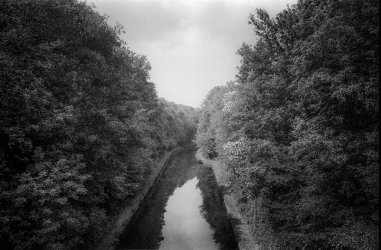
2018, Nikon F3 / Nikkor 28/2.8 / Kodak T-Max 400 /DDX

2016, Nikon D7000 / Nikkor 17-55 f2.8

Thats a good point Tommy, wonder if this can be adjusted in PS?Digital may have more definition or sharpness in the foliage but the film image hold the highlights and detail in the water nicely.


Then you also need to return with digital medium format as well to be balanced !I should add that I think both are far from perfect. I intend to return to these places with a medium format film camera in due course.
Then you also need to return with digital medium format as well to be balanced !
I believe that MF is better than 35mm in terms of film. The structure of MF film is different and unique, as I understand it, both 35mm and MF are totally separate film stocks. It doesn't mean to say that you can't take wonderful images with 35mm, of course not. It's just that for the connoisseur the difference is there to seen...I feel that the difference is best viewed from a large print though.That sounds very expensive!
No, my interest is in translating the 'ambiance' of landscapes. I suspect that film does is best, and MF film does it better that 35mm.


Joanna, pixels and image size have nowt to do with how the image is rendered once captured by the photosites. There is so much going on after in terms of how the digital information is processed by the camera's processor, so it's nigh on impossible to make a digital image take on the guise of film. However camera's like the D700 come pretty close IMHO...If I may butt in? Digital is perfectly capable of producing results just as good as film (within an equivalent format), provided the photographer knows how to get the best out of it.
I use a Nikon D810 (36Mpx), which gives me an image that is 7360px x 4912px.
If I scan a 6cm x 7cm negative at 2400ppi; that gives me an image of 6614px x 5669px.
So, I am getting a full frame digital camera image that contains approximately the same amount of information as a medium format film image.
What I have seen so often, when people make this comparison, is a lack of understanding of how to maximise the information in the digital image to give you the same "look and feel" as a film image.
If anyone has a film and digital version of exactly the same scene, taken at the same time, send me the RAW digital file, along with a file showing how the film version looks, and I will see what I can do to convince you. Don't forget, the RAW file must be just as correctly exposed, with no blocked or blown areas)
I throw down the gauntlet
With a RAW file, very little goes on in the camera; it's just a bunch of data taken directly from the pixels. The only processing that happens to an image in camera is when you take a jpeg.Joanna, pixels and image size have nowt to do with how the image is rendered once captured by the photosites. There is so much going on after in terms of how the digital information is processed by the camera's processor, so it's nigh on impossible to make a digital image take on the guise of film. However camera's like the D700 come pretty close IMHO...

Sorry Joanna but you are wrong, people are incorrectly informed that raw files are untouched...this is inaccurate. They have to be processed to a certain degree or otherwise how can you view them even as a JPEG on the back of your camera. The raw files have there data processed and prepared for your editing suite of choice. People talk about colour science and the Leica look etc, lenses aside, the reason for this is that the manufacturer has arranged for the raw file to have a certain amount of processing in- camera via S&R firmware blah blah... believe me it's trueWith a RAW file, very little goes on in the camera; it's just a bunch of data taken directly from the pixels. The only processing that happens to an image in camera is when you take a jpeg.
And I would have to disagree with your assertion that it is next to impossible to make a digital image look like a film image. Accept my challenge and I will show what is possible
I believe RAW files have a lower resolution JPEG preview embedded in them, using the setting of the camera at the time. Whether the RAW file is untouched or not is largely irrelevant because by the time you look at it it has been processed to some extent, either by viewing the embedded JPEG or by a computer that interprets that RAW data.Sorry Joanna but you are wrong, people are incorrectly informed that raw files are untouched...this is inaccurate. They have to be processed to a certain degree or otherwise how can you view them even as a JPEG on the back of your camera. The raw files have there data processed and prepared for your editing suite of choice. People talk about colour science and the Leica look etc, lenses aside, the reason for this is that the manufacturer has arranged for the raw file to have a certain amount of processing in- camera via S&R firmware blah blah... believe me it's true
I believe that should the digital sensor have sufficient dynamic range its possible to interpret the data as if it was developed film. Film is non-linear in a different way to digital sensors.Joanna, pixels and image size have nowt to do with how the image is rendered once captured by the photosites. There is so much going on after in terms of how the digital information is processed by the camera's processor, so it's nigh on impossible to make a digital image take on the guise of film. However camera's like the D700 come pretty close IMHO...