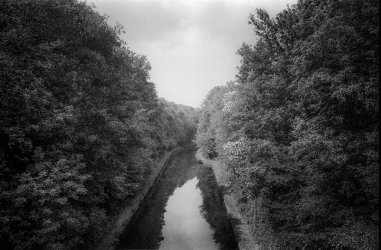
From Riqueval Bridge

Toby Webster

Well-Known Member
Registered
i69lzf.jpg


2018, Nikon F3 / Nikkor 28/2.8 / Kodak T-Max 400 /DDX

q0n3Rv.jpg


2016, Nikon D7000 / Nikkor 17-55 f2.8
 
An interesting comparison, its hard to call viewing on screen but digital shades it "Just" for me. Slightly more defined in the foliage to my eyes, it would be interesting to hear some one else's comments...
 
Digital may have more definition or sharpness in the foliage but the film image hold the highlights and detail in the water nicely.
 
I like the detail of near leaves from digital and prefer distance area of film

lighting/clouds looks more interesting on the film version, just a better day I guess

It would be interesting to see if you could edit the digital version to give similar contrast etc to film version down the middle of pic
 
I found this exercise interesting. In the (much more revealing) full-sized files the digital image has an immediate advantage in the clearer definition and tonal 'lushness' of the foliage, but the sky and much if its reflection in the water is, as you have pointed out, effectively lost. The film image lacks the lush richness and detail in the foliage of the digital, but once you get past that it is, I think, ultimately the more compelling and complete of the two, with detail in the sky and water and a rather lovely luminosity that develops towards the back of the frame.

I've been trying to work out why the foliage appears so much richer in the digital image, and I have realised that it was taken in late May, with all the young, pale shoots, whilst the film image was taken in August, when the leaves are starting to dry out a little.

Simon, I will follow up your suggestion as to the contrast across the water and the reflection of the trees, thank you.

The film file wasn't scanned using Martin's linear RAW technique, but as a DNG, so opened through Adobe RAW into PS, which allows for a fairly high degree of adjustment and opening of shadows. I do have a linear raw version to process out too.
 
I should add that I think both are far from perfect. I intend to return to these places with a medium format film camera in due course.
Then you also need to return with digital medium format as well to be balanced !
 
Then you also need to return with digital medium format as well to be balanced !

That sounds very expensive!

No, my interest is in translating the 'ambiance' of landscapes. I suspect that film does is best, and MF film does it better that 35mm.
 
That sounds very expensive!

No, my interest is in translating the 'ambiance' of landscapes. I suspect that film does is best, and MF film does it better that 35mm.
I believe that MF is better than 35mm in terms of film. The structure of MF film is different and unique, as I understand it, both 35mm and MF are totally separate film stocks. It doesn't mean to say that you can't take wonderful images with 35mm, of course not. It's just that for the connoisseur the difference is there to seen...I feel that the difference is best viewed from a large print though.
 
Last edited by a moderator:
If I may butt in? Digital is perfectly capable of producing results just as good as film (within an equivalent format), provided the photographer knows how to get the best out of it.

I use a Nikon D810 (36Mpx), which gives me an image that is 7360px x 4912px.

If I scan a 6cm x 7cm negative at 2400ppi; that gives me an image of 6614px x 5669px.

So, I am getting a full frame digital camera image that contains approximately the same amount of information as a medium format film image.

What I have seen so often, when people make this comparison, is a lack of understanding of how to maximise the information in the digital image to give you the same "look and feel" as a film image.

If anyone has a film and digital version of exactly the same scene, taken at the same time, send me the RAW digital file, along with a file showing how the film version looks, and I will see what I can do to convince you. Don't forget, the RAW file must be just as correctly exposed, with no blocked or blown areas)

I throw down the gauntlet :p:cool:
Joanna, pixels and image size have nowt to do with how the image is rendered once captured by the photosites. There is so much going on after in terms of how the digital information is processed by the camera's processor, so it's nigh on impossible to make a digital image take on the guise of film. However camera's like the D700 come pretty close IMHO...
 
Joanna, pixels and image size have nowt to do with how the image is rendered once captured by the photosites. There is so much going on after in terms of how the digital information is processed by the camera's processor, so it's nigh on impossible to make a digital image take on the guise of film. However camera's like the D700 come pretty close IMHO...
With a RAW file, very little goes on in the camera; it's just a bunch of data taken directly from the pixels. The only processing that happens to an image in camera is when you take a jpeg.

And I would have to disagree with your assertion that it is next to impossible to make a digital image look like a film image. Accept my challenge and I will show what is possible :)
 
Joanna, as my personal photographic style has developed over the last decade or so, I have increasingly used film as my reference, and process through my digital raw files to bring them as close as I can to how I would expect the finished photo to look as though it were on film. I don't think I'm too bad at it now. But to this end a couple of years ago on a couple of visits to France I carried both 35mm film and digital cameras, and took a few direct comparison shots, really just to see what I could learn towards the end of achieving that elusive 'filmic' look with digital files. In the end the experiment failed, largely because I had forgotten how to use a film camera properly and kept missing focus, and my processing and scanning wasn't great either, so the analogue files were mostly awful! This disillusioned me, and I reverted to pure digital, but the film attraction won't shake, and I'm finding myself doing it again, this time taking more care.

In 2016, I visited the McCullin retrospective in Somerset, and I also visited the Paul Hart exhibition in Cambridge last December. Paul also had a few Fay Godwin prints by Peter Cattrell hanging beside his own work to show her influence on him, so three masterclasses in two in medium format film photography and wet gelatin silver printing. Both visits served to convince me that digital or perhaps even analogue/digital hybrid printing cannot reach the tonal richness and range of pure analogue work. There is something in the density and richness of the blacks in particular, but the infinitesimally subtle shifts in tonality can also not be matched. Paul Hart is entirely unafraid of letting his blacks go in a way that I know wouldn't work with digital files. But there's more, a textural quality in the way film, particularly MF, renders that I haven't been able to achieve with digital, and there's a depth and presence that you can't quite articulate, its almost more a 'feeling', a tactile quality in the optic sphere if you like.

I think a while back I posted some digital/film comparisons on here and challenged people to pick which was which. I'll post them again, for fun.
 
Toby, both images look fine. Obviously the grain is noticeable in the film image but that's not a bad thing and you could have simulated grain digitally in the bottom image. I don't believe medium format is going to improve the image unless you're going to print a HUGE print.
 
Thanks Steven. I would have processed in some grain on the digital file as I always do, but clearly at a very fine level because it is imperceptible to me at upload size. Interesting what you say about MF and huge prints - Fay Godwin's gallery prints aren't more than about 500 x 350 mm and some are a lot less. The last Michael Kenna exhibition that I visited I forgot to take my reading glasses and could hardly see a thing, so small are his prints!
 
With a RAW file, very little goes on in the camera; it's just a bunch of data taken directly from the pixels. The only processing that happens to an image in camera is when you take a jpeg.

And I would have to disagree with your assertion that it is next to impossible to make a digital image look like a film image. Accept my challenge and I will show what is possible :)
Sorry Joanna but you are wrong, people are incorrectly informed that raw files are untouched...this is inaccurate. They have to be processed to a certain degree or otherwise how can you view them even as a JPEG on the back of your camera. The raw files have there data processed and prepared for your editing suite of choice. People talk about colour science and the Leica look etc, lenses aside, the reason for this is that the manufacturer has arranged for the raw file to have a certain amount of processing in- camera via S&R firmware blah blah... believe me it's true
 
Sorry Joanna but you are wrong, people are incorrectly informed that raw files are untouched...this is inaccurate. They have to be processed to a certain degree or otherwise how can you view them even as a JPEG on the back of your camera. The raw files have there data processed and prepared for your editing suite of choice. People talk about colour science and the Leica look etc, lenses aside, the reason for this is that the manufacturer has arranged for the raw file to have a certain amount of processing in- camera via S&R firmware blah blah... believe me it's true
I believe RAW files have a lower resolution JPEG preview embedded in them, using the setting of the camera at the time. Whether the RAW file is untouched or not is largely irrelevant because by the time you look at it it has been processed to some extent, either by viewing the embedded JPEG or by a computer that interprets that RAW data.
 
Joanna, pixels and image size have nowt to do with how the image is rendered once captured by the photosites. There is so much going on after in terms of how the digital information is processed by the camera's processor, so it's nigh on impossible to make a digital image take on the guise of film. However camera's like the D700 come pretty close IMHO...
I believe that should the digital sensor have sufficient dynamic range its possible to interpret the data as if it was developed film. Film is non-linear in a different way to digital sensors.

Digital technology should evolve to have a significantly larger dynamic range than film

Native RAW data doesn't exist in a physical way which film does. Digital technology interprets RAW data and creates an emissive (emits light) interpretation of it. Film reflects or allows some light to be transmitted due to physical particles or dyes.

The only true way to compare is to 'print' the digital data and then compare
 
2020-03-04-0001_1080.jpg

2020-03-04-0001_1080.jpg

Probably difficult to see the differences at this size, but I've followed Simon's suggestion and increased the contrast in the water. I've also opened out the lighter areas of the foreground trees on both sides, and cleaned the sky and water up a bit more. That'll do for now. Onto something else.

The location, incidentally, is of some import to WW1 historians, as the German Hindenberg line was broken here in bitter fighting in September 1918, by Australian, British and American troops under the field command of the outstanding Australian General Monash. Losses amongst the inexperienced Americans were their highest of the war, but the fighting here effectively marked the end for the Germans, although the war would grind on for another couple of months.
 
Back
Top