Fuji Neopan Acros II

That's excellent, Ian, thank you, I'll print off a copy. It seems to indicate that my guessed dev time for the film at 21 degrees was about right.

You are undoubtedly right about the shadow loss. In the samples that I've seen of the film being pushed, that has often been the case. I noticed both from my own negs and from reviews of the film that it is inclined to flatness in overcast conditions, and I feel that an extra stop would then be beneficial in terms of both usability and aesthetic. I've got several rolls of 120, I might try it with one of those at some point.
 
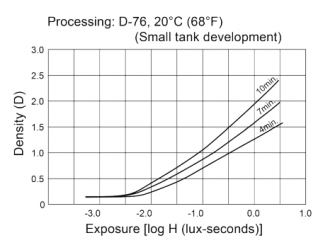
If we look at the curve for this film in D76 / ID-11 then we can see how different development times affect the contrast.

Even at the suggested 10 mins the curve is not as steep as some other films so by nature it could be classed as a lower contrast film to start with. Maybe this is a contribution to why it's reciprociry failure is one if not the best of all black and white films.

1658646114618.png

Personally, I am not a huge fan of it because to me it seems to lack this organic feel I like to see in films, but having said that it's a lovely fim to use for pinhole as you dont need to worry about reciprcity up-to 2 minutes and even at 2 minutes it's only an extra 1/2 stop.

If you like to have open shadows then getting the density onto the film has to be one of the most important parts of the exposure which boils down to how the scene is metered.

If the photographer is unable to accurately meter the deepest detailed shadows then the best alternative is to give the film more exposure so that you have plenty of density on the straight line portion of the curve and not all bunched up in the toe. This is also going to give better seperation in the mid-tones.

Then control the highlights through development by reducing the time.

NB: Don't over-fix the film as this can lead to loss of delicate shadow's if one isn't careful
 
This is excellent information, Ian, thanks again.

I'm just scanning a second film out of another OM2n - I bought two of them in a single lot.
 
I know exactly what you mean about the 'look'. It's very smooth and grain-free, almost 'digital'. It reminds be a bit of XP2 in that regard.
 
It's very smooth and grain-free, almost 'digital'
OK, you've asked for it now :D

Digital images only look digital because some folks like them that way. I use DxO PhotoLab and FilmPack, which allows me to give whatever look and feel I want to my images.

Here is a screenshot of a crop of a shot taken on a Nikon D810 (36Mpx) at 10,000 ISO, processed with only a straight B&W conversion…

Capture d’écran 2022-07-24 à 12.20.39.png

But then I can apply DeepPRIME noise reduction and get a "cleaner" version…

Capture d’écran 2022-07-24 à 12.24.33.png

However, what I do is to use the FilmPack Fuji Acros 100 emulation instead of just a crude conversion…

Capture d’écran 2022-07-24 à 12.26.19.png

Now, this is with the default Fuji Acros grain, scaled for a 24mm x 36mm negative - I can change the grain size down to that of 5" x 4" film if I want or need, or I can apply the grain from another film entirely. Here's a version with the grain from Ilford HPS 800…

Capture d’écran 2022-07-24 à 12.28.56.png

So, if a film looks smooth, it isn't looking "digital" it's just looking like the film it is.

Digital doesn't have a "look", it is whatever a skilled photographer makes of it.

OK, Whinge over - normal service can now be resumed ;)
 
Last edited:
I'm not sure what your point is, Joanna. I'm perfectly capable of overlaying grain onto my digital photos. In fact, I always do so.

And the reason why I do so is to make them look less 'digital', and more like film.

;)
 
I'm not sure what your point is, Joanna

My point is that some film photographers seem to insist that film images shouldn't be processed to look too "smooth" in case folks think they're digital, as if it were a derogatory term. My examples were to show that there is no way you can tell whether a print is film or digital, especially if it is a digital file printed by Ilford on their beautiful Lambda printer.

is to make them look less 'digital', and more like film.

But you have just said that some film can look digital because it is too smooth, so I don't know what you are getting at.

PS Its a shame you missed the focus on that portrait.

Now that is downright rude. I said it was a crop and here's the full image…

JNA_0069_4_DxO.jpg

It looks wonderful printed to A2
 
My point is that some film photographers seem to insist that film images shouldn't be processed to look too "smooth" in case folks think they're digital, as if it were a derogatory term. My examples were to show that there is no way you can tell whether a print is film or digital, especially if it is a digital file printed by Ilford on their beautiful Lambda printer.


But you have just said that some film can look digital because it is too smooth, so I don't know what you are getting at.


Now that is downright rude. I said it was a crop and here's the full image…

View attachment 15267

It looks wonderful printed to A2

You're being pedantic, Joanna. I follow quite a lot of film photographers, past and present, and I don't see anyone mention that Ilford Pan F, for example, is too smooth. I think that the point that Ian made upstream, and with which I agree, is that Fuju Acros can (arguably) lack that almost elusive to describe 'film look'. Martin and I have both expressed the same reservations about XP2 in the past, and have compared it to digital files.

Digital isn't 'smooth' because people want it that way, it is smooth because the technology increasingly renders digital files in extreme detail and resolution, and without artefects. The vast majority of digital camera users are undoubtedly perfectly happy with that, but a minority find that these very smoothly-toned, high-resolution images lack a certain organic, natural 'feel' and prefer the look of traditional film. In response to that a number of companies, including DXO and Nik, have created software that emulates that 'look' of film and overlays it onto digital files. As a longtime user of such software, I am fully aware of exactly what it offers, and indeed, what it sometimes doesn't quite deliver.

When we made those comparisons of specific films to digital files, it need hardly be said that we were not referring to post-processed digital files that had been overlaid with film grain.

I have seen photographs that had been printed on Ilford's Lambda printers, and they are indeed beautiful. It is a pretty exclusive, niche technology though, and most people will never have heard of it, less still seen it. Again, you are being pedantic.

I'm sorry that you were offended by my observation relating to your photograph. I regret that the uncropped version doesn't change my opinion. Personally I'd drop some fine film grain onto it, I find it can serve to tighten things up a bit.

;)
 
Fuji Acros as other slow films are inherently fine grain, you have to choose the right subjects for it to be effective, Acros excels at capturing fine detail such as in macro photography and its icing on the cake is for long exposure work be it pinhole, using ND filters and shooting at night because of its lack of reciprocity failure, so its a tool that's dependent on your type of photography.

I like grain as it does add a textural quality that defines film, however, what suits one will not suit all, for people that like to do low light photography and pinhole work Acros is one of the best films for that type of imagery,

I am not one for adding film effects, as good as the are they are effects that sit on top of a file rather than be an integral part of the film mechanics, the grain is the picture be it fine or rough.

So maybe try another film type Toby, experiment and see which suits you most of the time.
 
Oh, I do experiment, Martin, which is why I bought some Acros 2 a while back. In fact it was directly in response to a post that you made on this forum.

Having said that, my go-to's are Ilford's FP4 and HP5. I too love the grain, and also the 'luminosity' that these films often express. In fact, I've got some new HP5 in 35mm and 120 on the way from AGP even as we speak.
 
Fuju Acros can (arguably) lack that almost elusive to describe 'film look'.

And there you reinforce my point. What is a "film look"? Just as I have proven, there is no such thing as a "digital look".

No, Fuji Acros film looks like Fuji Acros film was intended to look. XP2 film looks like XP2 film was intended to look.

If you don't like the look of a particular film, simply don't use it - find another film that you do like.

If you don't like the look of digital images, as they come out of the camera, change them or go back to your favourite grainy film.

When we made those comparisons of specific films to digital files, it need hardly be said that we were not referring to post-processed digital files that had been overlaid with film grain

And yet, if you take the RAW file, shot at 10,000 ISO, without any noise reduction, it does have "grain", or to be pedantic, noise.

But I use Acros for my LF work, because I specifically don't want grain, especially when I am printing up to 50" x 40".

I'm sorry that you were offended by my observation relating to your photograph. I regret that the uncropped version doesn't change my opinion

Obviously, you are happy to denigrate another photographer's work based on a low resolution export of a 36MPx file in a forum that doesn't render such images that well.

Thank goodness I think you are talking bovine excrement and will try to ignore replying to such in future
 
Incidentally, Joanna, bovine excrement apart, I'm not 'denigrating' your work, I'm merely critiquing it, which I think is one of the objectives of this forum.
 
I think Joanna is being a bit harsh here. What Toby is saying makes perfect sense to me, because I too like a bit of grain. My favourite films are FP4 and HP5. I also like Foma 400 for some subjects, as it has quite a lot of grain, and a strong visual character. I actually have quite a strong aversion to pristine grainless black and white landscape photographs, which often look bland and somehow unreal to me, though I can understand why some people like them. A hint of grain makes all the difference for me.

Alan
 
I think Joanna is being a bit harsh here
I wasn't being harsh, just pointing out that continuously comparing film and digital is a lost cause. Each has their strong and weak points and both can be made to look like the other. It simply isn't true that one is better than the other - horses for courses, different strokes for different strokes, etc.
 
Its no less valid to compare film with digital than it is film with film, or digital with digital, DSLRs with mirrorless or phones, or even film with phones.

And I don't think anyone was saying that one was better than the other. It is an entirely subjective thing, and we are fortunate enough to live in two countries in which we remain - thus far - perfectly at liberty to discuss such interests with like-minded people..

I spent 10 years trying - not without a reasonable degree of success - to bring to my digital black & white photos something of the luminosity and falloff that (possibly) defines a 'look' that great film photography can sometimes express. In the end I found that the experience of using digital cameras was increasingly unrewarding, and that the joy of photography returned to me when I started to use film cameras again, most specifically a couple of years ago when I bought my first ever 120 format camera. I also acknowledged to myself that, however successful my efforts with Photoshop and add-ons such as Nik, AlienSkin & DxO, there remained something elusive that film offers to me, and which software-enhanced digital captures usually fall just short of. I am far from alone in that.

I happen to think that the comparison is an interesting and engaging one, and it is also a useful reference for those who are at an earlier stage in their own journey with photography, one for which the DMF provides a very useful, if sadly somewhat underused, platform.

I actually still use digital cameras, particularly for colour work, family photos, events and commercial stuff at work, and I also use my phone cam. I have found that using and learning about film has actually improved my digital photography and post-processing, and made me take more care (and fewer photos).
 
Last edited:
I think Joanna is being a bit harsh here. What Toby is saying makes perfect sense to me, because I too like a bit of grain. My favourite films are FP4 and HP5. I also like Foma 400 for some subjects, as it has quite a lot of grain, and a strong visual character. I actually have quite a strong aversion to pristine grainless black and white landscape photographs, which often look bland and somehow unreal to me, though I can understand why some people like them. A hint of grain makes all the difference for me.

Alan

I completely agree with this. It remains, of course, an entirely subjective thing. I'm a great admirer of a number of excellent photographers whose fine art, long exposure (digital) photos are pretty stunning, though I do sometimes wish they were't quite so clean!

Mark Tracey, Joel Tjintjelaar, Bruno Mercier, Arnaud Bathiard, Tony Hunter, Tony Sellen, Christophe Staelens, Jay Vulture, Noel Bodle, Rohan Reilly & Vassilis Tangoulis are all using digital. My hero of street photography, Eric Mencher, only uses an iphone.
 
Back
Top