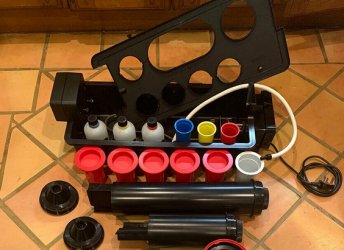
JOBO CPE2

super_claret

Active Member
Registered
After buying myself a Zeiss Ikon Nettar and seeing the results printed, I'm hooked on this home developing lark :)
It got me thinking about shooting transparencies and colour negative film but the thought of processing and the degree of accuracy required is putting me off a little. I then came across a YouTube video about the Jobo CPE2.

Has anyone got any experience with these processors that could offer advice? Any pitfalls to look out for? I'm particularly interested in the lift model, as I'd like to make things as easy as possible.

Thanks in advance
 
I have used one for around 30 years and whilst they are not a precision piece of kit they do help with keeping the temps close enough to get a result. It may take a while to get the thermostat set so that you can guarantee more or less you will be in the right area. with the setting of 20c for B&W films you may find that you actually need 22 even 23 degrees. The reason for this is whilst the main water bath may get to 20c the plastic beakers seam to absorb some of the heat and unless you are prepared to wait a long time you have to set the temp a touch higher. for colour neg films the temp is 38C but I set mine to about 41C

Colour negative film is about as easy as it gets with a JOBO, but transparencies, especially the first developer has to be pretty well spot on otherwise when you come to the 2nd developer if the 1st developer was too low they will appear a little dark, too high and they will appear washed out and lacking in saturation.

The warming of the tank beforehand will help avoiding the temp too cold and some swear by a water bath beforehand at 40C to heat the tank up. I am a little different and don't like the idea of a water bath, so when the film is loaded into the tank and before it is switched on I place the developing tank into the water bath when it is cold and during the time it takes to heat up to the correct temp this also raises the tank and the film it contains up as well. I have never had a problem with that method.

Take care when putting the lid on the tank after loading the film because it sometimes may seem as if it is on and the cap secure, but it may not be. When this happens during the processing the developer fixer etc will leak out and the film will be ruined. The way to check, is to hold the lid and tank in your hands and give them an opposite twist and if the lid turns it turns, then the lid isn't secure. If it doesn't, you are good to go.

When processing transparencies, Tetenal used to advise you to used dedicated beakers for the 1st developer. 2nd developer and bleach fix stages. I don't know if they still do. This I understand is due to the plastic used in making the beakers can absorb some of the chemicals and in extreme cases cause cross contamination which can result in odd colours. I use graduated certified glass ones for my colour negative processing that fit snuggly into the holders in the JOBO tank. They wash out easily and don't get contaminated

You will need an accurate thermometer and I still use a certified mercury one which is as old as my JOBO. You cannot buy them now! I also have a digital electronic one, whilst not certified as accurate is very close to the Mercury one that makes no matter.

You say it is your intention to process transparencies. The E6 chemicals do not have a very long shelf life once opened. Perhaps a month so. With the price of a kit and the cost of film. plus mounting, for me it isn't a viable option (About £20 to £25 a film) and to be honest I find the process boring. Colour negative developer does seem to have improved over the last few years and remains stable for a long time and the developing time is an awful lot quicker.
 
Last edited:
I have used one for around 30 years and whilst they are not a precision piece of kit they do help with keeping the temps close enough to get a result. It may take a while to get the thermostat set so that you can guarantee more or less you will be in the right area. with the setting of 20c for B&W films you may find that you actually need 22 even 23 degrees. The reason for this is whilst the main water bath may get to 20c the plastic beakers seam to absorb some of the heat and unless you are prepared to wait a long time you have to set the temp a touch higher. for colour neg films the temp is 38C but I set mine to about 41C

Colour negative film is about as easy as it gets with a JOBO, but transparencies, especially the first developer has to be pretty well spot on otherwise when you come to the 2nd developer if the 1st developer was too low they will appear a little dark, too high and they will appear washed out and lacking in saturation.

The warming of the tank beforehand will help avoiding the temp too cold and some swear by a water bath beforehand at 40C to heat the tank up. I am a little different and don't like the idea of a water bath, so when the film is loaded into the tank and before it is switched on I place the developing tank into the water bath when it is cold and during the time it takes to heat up to the correct temp this also raises the tank and the film it contains up as well. I have never had a problem with that method.

Take care when putting the lid on the tank after loading the film because it sometimes may seem as if it is on and the cap secure, but it may not be. When this happens during the processing the developer fixer etc will leak out and the film will be ruined. The way to check, is to hold the lid and tank in your hands and give them an opposite twist and if the lid turns it turns, then the lid isn't secure. If it doesn't, you are good to go.

When processing transparencies, Tetenal used to advise you to used dedicated beakers for the 1st developer. 2nd developer and bleach fix stages. I don't know if they still do. This I understand is due to the plastic used in making the beakers can absorb some of the chemicals and in extreme cases cause cross contamination which can result in odd colours. I use graduated certified glass ones for my colour negative processing that fit snuggly into the holders in the JOBO tank. They wash out easily and don't get contaminated

You will need an accurate thermometer and I still use a certified mercury one which is as old as my JOBO. You cannot buy them now! I also have a digital electronic one, whilst not certified as accurate is very close to the Mercury one that makes no matter.

You say it is your intention to process transparencies. The E6 chemicals do not have a very long shelf life once opened. Perhaps a month so. With the price of a kit and the cost of film. plus mounting, for me it isn't a viable option (About £20 to £25 a film) and to be honest I find the process boring. Colour negative developer does seem to have improved over the last few years and remains stable for a long time and the developing time is an awful lot quicker.

Thank you John. So grateful for the advice. I think I’ll take your advice re the transparency processing and give it a miss.
I may still purchase a Jobo As it seems it does have advantages, especially if I want to develop more than 1 film or have a go at C41.

Would you recommend getting the lift version? I’ve watched various YouTube videos and the lift does seem to make the process easier.
 
I have never used the lift version. It just added to the cost of purchase and I could not see the point. If someone uses one and they can say if they are worth it go ahead. The latest version of the CPE2 (is it the 3 version) are very expensive and used CPE2 ones appear every now and again, but I cannot recall seeing a lift version for sale 2nd hand.
 
I used one of these in the 80's for all my colour print work, I had the manual version, it was great to use with a heated tray underneath, I still have both of them, I use the heated tray in winter for my film's, but have not done any colour prints for 30 years. I see there are some on ebay
 

Attachments

  • Patterson1.jpg
    Patterson1.jpg
    203.9 KB · Views: 3
There is a company called Second Hand Darkroom Supplies and they have what looks like a very nice Jobo CPE2. (Non lift model) To look at what it is like just google the name. They have it priced at £349.00.
They are quite well made and the one I use is at least 22 years old an going well.
 
There is a company called Second Hand Darkroom Supplies and they have what looks like a very nice Jobo CPE2. (Non lift model) To look at what it is like just google the name. They have it priced at £349.00.
They are quite well made and the one I use is at least 22 years old an going well.
Yes, I've seen that one and may take the plunge. Just out of curiosity, if I were developing 2x 120 films, how much chemical would I need? I use 500ml for single 120 films in my Paterson tank. Reason for asking is that the storage bottles on the Jobo are 600ml.
 
Normally with a JOBO tank in their processor, for rotary processing you need 250cc and for 35mm a minimum of 150cc but I use 160cc

Patterson tanks will not work in a JOBO processor, they have to be driven by a magnet attached to the base and there is no place fit a magnet to a Patterson tank.
 
Normally with a JOBO tank in their processor, for rotary processing you need 250cc and for 35mm a minimum of 150cc but I use 160cc

Patterson tanks will not work in a JOBO processor, they have to be driven by a magnet attached to the base and there is no place fit a magnet to a Patterson tank.
Thanks John, I was aware about the Paterson tanks not fitting the Jobo, I was just referring to how much chemical I use in the Paterson.

So, 250ml for a single 120 film? What about 2x 120, any ideas?
 
The quantities are usually molded onto the plastic tank itself. Can you actually get 2 x 120 films onto one spiral? I have never tried it.

If you are using a 120 tank not with the JOBO then as I recall the quantity is usually 500cc or therabouts. That will be enough for 2 x 120 films but I would only use it once and discard.
 
Been busy with other things over the last few months but finally found a Jobo CPE2 with lift for a reasonable price. I’ll report back when I’ve had chance to use it.

I’m going to process a test roll of HP5 Plus in ID-11 (1+3) at 20C for 17 minutes. Normal time in my Paterson tank would be 20 mins but deduction of 15%, as recommended by Ilford for rotary processors, make it 17 minutes. I’m hoping this will work out OK but we’ll see.
With ID11 and most B&W films I would find a 20% reduction in time and a reduction of exposure by around 1/3 stop will give a more printable negative. With Fomapan 200 which is soft working anyway the 15% is probably closer to the mark.
 
With ID11 and most B&W films I would find a 20% reduction in time and a reduction of exposure by around 1/3 stop will give a more printable negative. With Fomapan 200 which is soft working anyway the 15% is probably closer to the mark.
Thanks John. Just to point out that I don’t print in the darkroom, I scan and print inkjet. Would you still recommend a 20% reduction in dev time?
 
When scanning a negative I always find that a slightly denser, but not so contrasty neg gives a better tonal range and if the scan is still a little flat there are a myriad of ways to bump it up a little.
What you find may suit you, what I have suggested is for darkroom printing so we may differ in what we need or think is best. It will be down to a bit of experimentation.
 
I processed my first roll of FP4 with the Jobo yesterday and happy to report it was a success. First thing I noticed was how easy the Jobo reels are to load. The whole process was a pleasure.
 
When scanning a negative I always find that a slightly denser, but not so contrasty neg gives a better tonal range and if the scan is still a little flat there are a myriad of ways to bump it up a little.
What you find may suit you, what I have suggested is for darkroom printing so we may differ in what we need or think is best. It will be down to a bit of experimentation.
That’s my findings as well John,
 
Back
Top