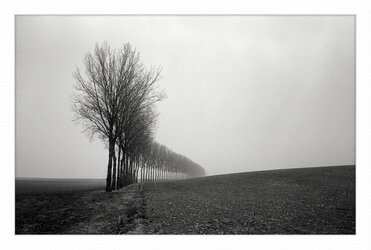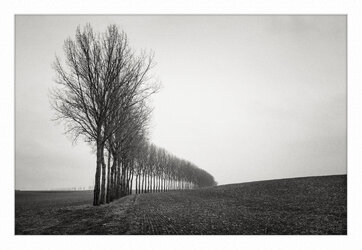
Thiepval Poplars

Toby Webster

Well-Known Member
Registered
20180303_3301_1024.jpg
Nikon D7200 Nikon 17-55 f/2.8 DX PS/ColorEfex
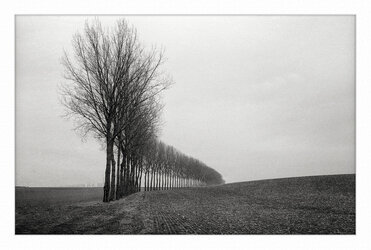
2018-04-19-0002_1024.jpg
Nikon F3, Nikon 24-120 f/3.5-5.6 Ilford Delta 400, Ilfotec DD-X 1/4 6.5 mins, Nikon Coolscan IVED, Vuescan, PS/ColorEfex
 
Interesting exercise Toby and well worth doing. I much prefer the tones and detail in the ground and the slightly overall muted feel in the film image. And I like the image as well.
 
Both of these images have their merits, the digital version has a nice glow in the sky above the line of trees which lifts the atmosphere for me. However ultimately you would have to print them to complete the comparison.....
 
I have to say that the differences are much more pronounced at full-size. The D7200 version looked like plastic by comparison with the film version, until I dumped some pretty strong grain into it. The D7200 files are much less noisy in the first place, and much more resistant to digital grain, than were the files from my older D7000.

I use grain in all my digi images, colour and B&W, even the 'product shots' I use for my business website. It doesn't have to be enough to really see, but it renders the image far more organic.

I had awful problems scanning this negative, it was the end one, and curled. If I put it into the scanner one way, the right hand side fell out of focus, the other and the top of the tree was oof. I ended choosing the best of the former, and introduced some grain just into the out of focus area of the sky that was affected. The grain pattern is very authentic.
 
What is interesting is that when we scan a negative and then process it in PS/LR then we have a sort of hard template, in the dark room every print is different and unique. You would lose some kind of consistency with the traditional method which is present in the digital dark room...swings and roundabouts... :-(
 
The digital one for me. That row of trees background left are better delineated and add to the image's interest whereas you could easily miss then on the other. I think that the trunks of the main trees have better micro contrast which, to my eye also adds to making it a more pleasing image.
 
I like them both but if pressed and not told beforehand which was which (or why) I would have chosen the first (digital) one
 
I have now started to use FP4 125 instead of the 400 ASA films, I suspect that it will 'tighten up' these landscape shots. Although the grain is relatively fine, particularly in the Tri-X, any attempt to pull the sky down in PS seems to serve to coarsen the grain structure unacceptably. I have also bought a fixed 28mm Nikon 2.8 ai lens to use instead of the ungainly and probably less than brilliant 24-120.

Of the several attempts that I made of this scene in my March visit, I actually prefer this slightly more melancholy take from the previous day. It is on Tri-X 400. I incidentally much prefer the more delicate, less intrusive grain pattern in the Tri-X compared to either Delta 400 or HP5.

2018-04-18-0004_1024.jpg
 
"Although the grain is relatively fine, particularly in the Tri-X, any attempt to pull the sky down in PS seems to serve to coarsen the grain structure unacceptably"

This is a problem that i am experiencing Toby, i am wondering if the grain structure would be different with medium format film?
 
The reason why the grain becomes more evident when you bring the sky down from being very light to a darker tone is due to overexposure and development in the brightest areas.

Because we are dealing with a dynamic range of 5 stops where we can see texture (detail) usually from Zone 3 to zone 8 on the grey scale, you will find on a bright day that the lightest area, which in a landscape is undoubtedly the sky/clouds which should fall on around zone 7~8. When you develop roll films 35mm and MF you cannot alter the development time so suit the dynamic range, unless all the shots on the roll were taken in the same light with the same DR which is highly unlikely. If your range in the brightest part of the scene goes beyond zone 8 the films grain becomes exaggerated or even broken up as grain with patches of pure white , you usually cannot see that grain too much after scanning, it will be quite bright, however when you try to pull the brightness down the exaggerated grain is seen, and can look awful especially the small 35mm film.

One way around this, and because we are scanning and not developing to a particular paper grade is to reduce development time then build the contrast after scanning in Photoshop, I would suggest that you cut the normal development time by 15 or 20%, the shadows as long as they have been exposed correctly will not be affected only the higher tones from zone 7 and 8.

Another way is to use a semi-stand development, rather than reducing dev times by the amounts above reduce it by 10% minimal agitation is then given in the development process, the developer in the higher tones exhausts faster giving a lesser density on the negative, finer grain.

I would try the first method as semi-stand development can run into other problems, try it when you have a better understanding of whats happening during the chemical development process.

One word of caution, when reducing dev times make sure you don't go below the 5 min time, it can be a little too short for modern films.

Alan, makes no difference what film format you use if you don't get the correct exposure and dev times it will show even on Medium format film. It looks worse on 35mm because of its physical size in relation to the film type and its grain, plus enlargement (sizing in PS). Do the same as I have said by reducing dev times to MF as well as 35mm you will see an improvment
 
Last edited:
The reason why the grain becomes more evident when you bring the sky down from being very light to a darker tone is due to overexposure and development in the brightest areas.

Because we are dealing with a dynamic range of 5 stops where we can see texture (detail) usually from Zone 3 to zone 8 on the grey scale, you will find on a bright day that the lightest area, which in a landscape is undoubtedly the sky/clouds which should fall on around zone 7~8. When you develop roll films 35mm and MF you cannot alter the development time so suit the dynamic range, unless all the shots on the roll were taken in the same light with the same DR which is highly unlikely. If your range in the brightest part of the scene goes beyond zone 8 the films grain becomes exaggerated or even broken up as grain with patches of pure white , you usually cannot see that grain too much after scanning, it will be quite bright, however when you try to pull the brightness down the exaggerated grain is seen, and can look awful especially the small 35mm film.

One way around this, and because we are scanning and not developing to a particular paper grade is to reduce development time then build the contrast after scanning in Photoshop, I would suggest that you cut the normal development time by 15 or 20%, the shadows as long as they have been exposed correctly will not be affected only the higher tones from zone 7 and 8.

Another way is to use a semi-stand development, rather than reducing dev times by the amounts above reduce it by 10% minimal agitation is then given in the development process, the developer in the higher tones exhausts faster giving a lesser density on the negative, finer grain.

I would try the first method as semi-stand development can run into other problems, try it when you have a better understanding of whats happening during the chemical development process.

One word of caution, when reducing dev times make sure you don't go below the 5 min time, it can be a little too short for modern films.

Alan, makes no difference what film format you use if you don't get the correct exposure and dev times it will show even on Medium format film. It looks worse on 35mm because of its physical size in relation to the film type and its grain, plus enlargement (sizing in PS). Do the same as I have said by reducing dev times to MF as well as 35mm you will see an improvment
Is there a particular developer chemical that suits highlights when developing Martin?
 
Yes there are others, such as two-part developers Diafine, Pyrocat, Tetenal Neofine Blue, there normally called compensating developers, there are more out there.
They work by exhaustion in the higher zones giving a less dense negative with more detail without effecting grain. With Pyrocat HD I can have the Sun in the frame and get no blowout or exaggerated grain, the pinhole shots of Armscliffe Crag are a good example.
Thanks Martin that's interesting, I'll give it a go. I am working on a scan at the moment which looks much more promising than any others that I have scanned before, so I don't want to give up just yet...
 
Martin, very interesting, thank you.

I tried to buy some Pyrocat HD a couple of weeks ago, following your recommendations on the forum, but couldn't find a source. Can you point me please.
 
Back
Top