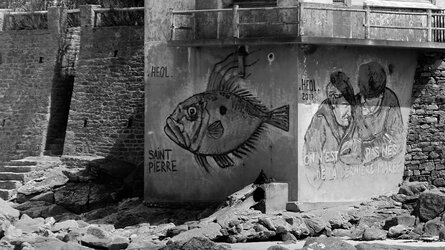
we weren't born yesterday

Thanks for the comment José. The only processing is the simulation of Ilford HPS 800 monochrome film. Maybe the shadows are throwing you - 1pm may not be the best time of day to be out with a camera.
 
Hmm - dissenting voice here ….:(

I'm a bit wary of photos of or including a lot of graffiti because unless there is something extra to add to the overall impact of the image it could be taken as a picture of someone else's artwork (graffiti in this case). Which to me then becomes a record shot - excellent as it may be as a record shot.

I like to use the 'Mona Lisa' test.

A picture of the Mona Lisa is a record of a work of art.

A picture of someone looking at the Mona Lisa in awe is telling a story.
 
Hmm,

If I was luck enough to find myself in front of this scene, what would I do?
Probably the same. It's doubtful I'd walk away because of the graffiti.
 
No problem with the graffiti.

I might be missing something ( and probably am) but to me it is a good photograph of (someone else's) graffiti.
 
Don't know if this will clarify but .......

..... at my photo club a (good) picture of some (great) graffiti was placed top by the judge. I couldn't see why.

Later in the year, at the image of the year competition, another judge scored it at about 16 out of 20. (Which I thought was a good decision.)

Even later I saw a picture of graffiti in a ?tunnel with a long shadow of someone (out of shot) with a knife. To me that was a far superior image.

It was the most sinister/threatening picture that I had seen for a long time time.
 
Chris,

I took the time to view your website and slide show, WOW!
What's so impressive is the deliberation in your photographs. That kind of seeing is almost unique in today's snapshot society. Aside for the, near perfect, post process the images themselves are mindful and deliberate.

You've inspired me to consider a slide show on my Pitcher Ghost Town project. That should be a good way to show the situation.

Thanks,
Joe
 
Thanks Joe and Chris for your comments.

it could be taken as a picture of someone else's artwork

It's interesting... I didn't think of it as borrowing from the artist's work, even though I consider it to be well done, but I did think it ought to have an audience. I took it because I thought it was unusual to see graffiti on a beach, and after some editing I was pleased enough with the result to upload it.

A loose translation of the message is: We weren't born on the last tide (hence the title).
 
I'm with you Peter. It's a good image no matter who did it. But then I'm a Copy Cat!

All of us can expand our visual ability. I work on it all the time. But photographic seeing is special. When one begins to see in the same way the camera does, magic can happen. One of my hero's, H. Callahan, spent his whole life developing his photographic seeing. There's no end to it.

Joe
 
Thanks for the pointer to Harry Callahan - some truly outstanding work there. I was also interested to read what Eric Kim learned from Mr. Callahan about street photography.
 
HC: "If and when a person becomes dedicated to seeing photographically, a new world opens up. With a properly used camera poetry can be written".He spent the last twenty years of his life studying the science of seeing.

He didn't conduct classes for the graduate studets. The method Callahan taught It was done by assignments and critiques. Once a month, all the classes and instructors would meet for a full couple of days of critiques. No formality. The photo's were all on display at once. The instructors would walk around asking questions and exchange idea's with the students. There was always a mob of students around the instructors. I remember Arthur Seigel, came with tons of books for us to go over. It could last to weee hours in the morning at a local restaurant or pub. He was slow and deliberate when directing us around the world of photographers. Everyone would be charged up for a full week.

Some students may not show back up for a week or so. But when they did you knew how hard they had been working.

All of this was due to Maholy and the New Bauhaus School.
 
Last edited:
Back
Top