


Taken in my home town of Otley in Wharfedale, I used my Zero image 4x5 pinhole camera at a setting of 50mm focal length, the aperture at this setting is f/176.
The fun of pinhole photography is you do all the ground work, setting and levelling up the camera, try to estimate what the composition is using a 4x5 cut out which I held approx 50mm from my eyes, then taking an exposure reading, adding reciprocity failure time, calculating dynamic range as best as you can and and dealing with people asking questions to what I am trying to do with a wood box with no lens , finally making the exposure and all the time not knowing what it's going to be like until the film is developed.
I did make it harder for myself with the Sun in the frame but I do think to do it this way with the camera pointing towards the light source makes for a more dynamic interesting image.
I used the BTZ metering, this is where you double the films iso, use the light meter in incident
reading mode and meter in the open shade, the exposure was 8secs @f/176 but with time added for reciprocity failure, the actual exposure was 21sec @f/176.
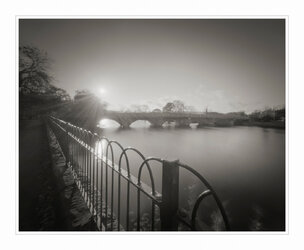
Zero 45 at 50mm
Ilford FP4+ rated at 200iso
Developed in Pyrocat HD
for 24mins.30sec minimal agitation method
Scanned with Epson v800 in Vuescan
The fun of pinhole photography is you do all the ground work, setting and levelling up the camera, try to estimate what the composition is using a 4x5 cut out which I held approx 50mm from my eyes, then taking an exposure reading, adding reciprocity failure time, calculating dynamic range as best as you can and and dealing with people asking questions to what I am trying to do with a wood box with no lens
, finally making the exposure and all the time not knowing what it's going to be like until the film is developed. I did make it harder for myself with the Sun in the frame but I do think to do it this way with the camera pointing towards the light source makes for a more dynamic interesting image.
I used the BTZ metering, this is where you double the films iso, use the light meter in incident
reading mode and meter in the open shade, the exposure was 8secs @f/176 but with time added for reciprocity failure, the actual exposure was 21sec @f/176.
Zero 45 at 50mm
Ilford FP4+ rated at 200iso
Developed in Pyrocat HD
for 24mins.30sec minimal agitation method
Scanned with Epson v800 in Vuescan


