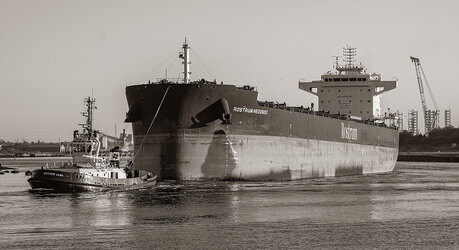
MV Rostrum Hedonist nationality Danish

John King

Well-Known Member
Registered
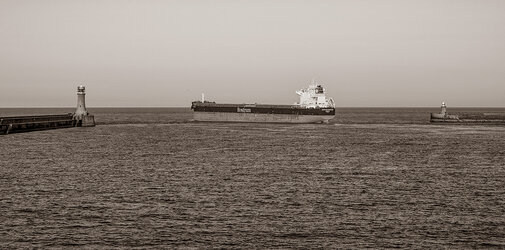
By chance I was out on my motorcycle on the 24th April in the evening when the vessel was leaving the River Tyne for Denmark. Danish owned, but flagged with Liberia and with a Deadweight of 82,178 tonnes. A general cargo vessel but principally transporting coal.
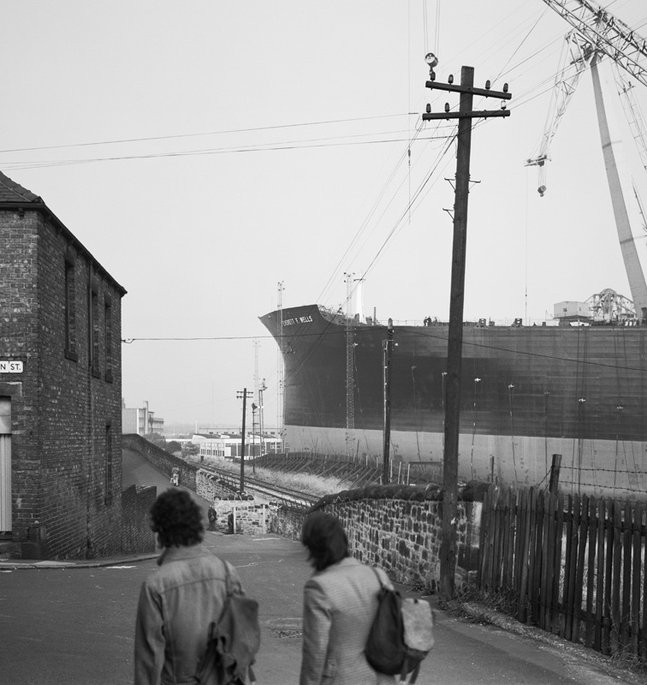
There was only a light wind in a cloudless sky and the river only with a few ripples. This is the biggest ship I have seen in the Tyne since the days of Esso Northumbria with a deadweight of 250,000 tones leaving the river in the 1960's on test after just being completed.

To put size into perspective, in the last picture the gap between the two lighthouses is over1/4 of a mile you can see how big it is.

The camera was a Nikon D90 with a Nikon 24/120 lens
 

Attachments
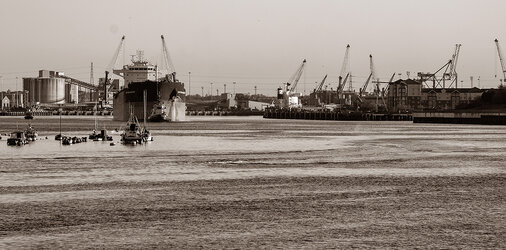
  • Rostrum 1.jpg
    Rostrum 1.jpg
    506.3 KB · Views: 24
  • Rostrum 2.jpg
    Rostrum 2.jpg
    471.4 KB · Views: 24
  • Rostrum 3 Leaving the Tyne.jpg
    Rostrum 3 Leaving the Tyne.jpg
    449.7 KB · Views: 24
Last edited:
Probably not as tall but almost certainly longer and heavier The DFDS ferries are only about 36000 tons according to the plaque attached to the side of the ships model displayed on board.
 
I remember seeing the Esso Northumbria being launched as a seven-year old. I must have been impressed by the spectacle to remember it all this time.
 
In have checked their dimensions and both ships that leave the Tyne for Holland are the same length as each other -about 3/4 as long as the Rostrum. But the biggest difference being the the actual weights:-
  • 31,788 Gross tonnage. Deadweight 82,178 tonnes (Rostrum)
  • Deadweight: 4,110 DWT–5,765 DWT and163 meters in length and 28 meters wide (DFDS}
It is vastly less than the Rostrum Hedonist. Also, and this is mostly a guess, because the Rostrum is mainly steel, where the Passenger ships do have a lot of aluminium in the construction. It is also significantly newer than the DFDS vessels, being built in 2023
 
Last edited:
I remember seeing the Esso Northumbria being launched as a seven-year old. I must have been impressed by the spectacle to remember it all this time.


It must have been an marvellous sight. All gone now.
 
The Rostrum Hedonist is currently in the Baltic heading for Ust-Luga in Russia. Being Danish owned, I wonder what cargo she is picking up given the current state of sanctions. Russian coal is the subject of current international sanctions?
 
Last edited:
Watching the film reminded me of the Chris Killip exhibition "The Last Ships" which is on permanent free display at the Laing Art Gallery in Newcastle:

 
Just watched the film, I was 8 years old then, later in life I spent a bit of time on the banks of the River Tyne.
There are some remnants left of those days but that's all.
 
Nice pics.

There's an interesting interview with Chris Killip on Martin Parr's channel. Both sorely missed.

 
Two nice, rather modest men who did some wonderful documentary work. I love Chris Killip's Tyneside photographs; as with all of his late 1970s work, they caught the tail end of something that was to very quickly vanish forever. The location of his famous photographs around the back-to-back terraces above the great dock at Swan Hunter is briefly visible in the Esso Northumbria piece. There's a certain irony that after they were demolished the foundations of Roman Fort of Segendunum would emerge, from the south-east corner of which the final few yards of Hadrian's great wall ran down to the bank of the Tyne, beneath Killip's pathway and playing children, the railway tracks, Princess Anne and all the dignitaries, and the great cranes in the shipyard, quite literally 'Wallsend', lost history layered upon lost history. Time is quite the most incomprehensible thing, bar our minuscule part in it.
 
Having been born and grew up on Tyneside, it came as news to me that I had missed the connection between and the back to back houses then the discovery of the Roman fort at Wallsend. Not long after the launch of Esso Northumbria, I had finished at Tech College and moved away from home so lost a great deal of contact, but that is nice to know what they found.

I returned to Tyneside, (Well close enough to it that makes no matter) 50 years later and buried my interest into the local history surrounding the mines, (lead and coal) railways, but pre Stephenson's' era and the wooden track ways where the motive power were horses pulling Chaldron wagons and Galloway Ponies that carried crudely smelted lead 'pigs' from Weardale to the Tyne to be refined. There are signs everywhere if you care to look and photograph.

In the same vein, I may be wrong but no one has contradicted me - yet, but I think I may have found what is a short (about 1/4 mile long forgotten rope hauled railway and I'm waiting for confirmation. It is marked on a early 19th C map as Rope Walk. but shows a link to where the current railway runs, partially built over now but looking at the place in the main it is still a footpath, I'm at looking all the dots all joining up.
 
Last edited:
Very interesting, John, as I say, layers of history, the mines of course pre-dating the Victorian terraces. Killip's photographs centred around Joan Street, Gerald Street and Davis Street, and Camp Road which ran alongside and just above the railway tracks, the course of which is now unromantically redesignated as 'Cycle Route 72'. Wallsend Colliery 'A' Pit was sited somewhere under Gerald Street, and the capped shaft of 'B' Pit is now exposed on Buddle Street, next to a section of the exposed foundations of Hadrian's Wall. The shaft was bankrolled by one John Buddle in 1780. There was a 'C' Shaft as well, but I haven't located it. There were two disasters in the underground workings, the first in 1821 and the second in 1835, in the latter event 102 men and boys, and a number of ponies' having been killed by the explosion itself or the fouled air which followed it. Both shafts were located just on the edge of the Roman fort. I assume the terraced houses were built in the mid-to-late Victorian era. I'm sure you have far more information on this than I do.

On the site of the series of Killip's photos on Camp Road at some point between Joan and Gerald streets, and at the corner of the fort, a Roman Bath house has been recreated. Ironically, some long time later when the Ship Inn on Gainer's Terrace (itself another of Killip's subjects), just below the railway, was demolished an actual Roman bath house was discovered below the cellars, the original and the recreation barely a stone's throw from each other.

Something of the atmosphere of this place was captured in the film 'Get Carter', which of course featured a shoot-out on the Wallsend Ferry terminal at the bottom of Benton Way, right beside the vast Swan Hunter dock, which itself survives (the ferry is long gone). Apparently the film crew vehicles were all parked on Gainer's Terrace for the filming of this sequence.
 
Back
Top