HMG guidance to immigrants regarding photographing people

Elines

Well-Known Member
Registered
There is a lot in the media about HMG’s guidance to immigrants.

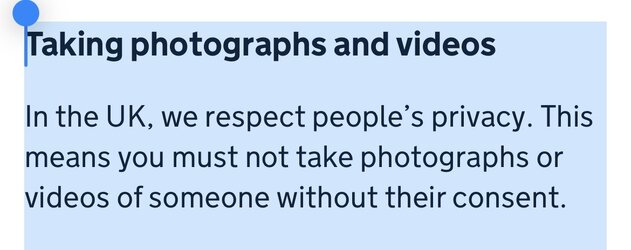
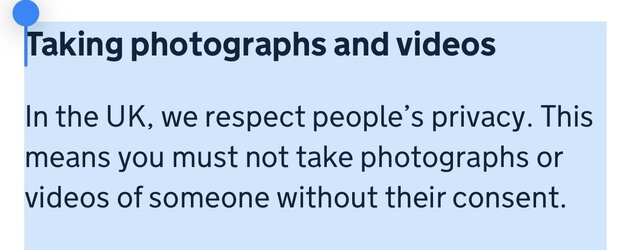
It includes a section on photography, which says:

‘You must not take photographs or videos of people without their consent.’

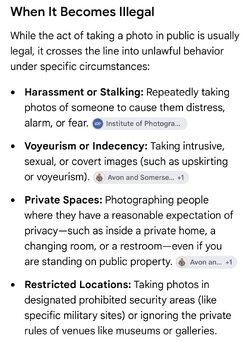
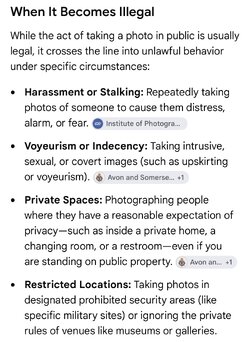
As I under it, consent is not legally required if you are in a public space, and a google search confirms this.

If the HMG guidance was correct then (eg) the whole genera of street photography would be illegal.
 

Attachments

  • IMG_3259.jpeg
    IMG_3259.jpeg
    85.7 KB · Views: 2
  • IMG_3260.jpeg
    IMG_3260.jpeg
    39.7 KB · Views: 2
  • IMG_3261.jpeg
    IMG_3261.jpeg
    351.2 KB · Views: 2
That has always been my understanding as well. However, keep in mind the definition of a "Public Place". It's not a place that the public have access to. It is a place in public ownership, generally via your local council etc. For instance shopping Malls may not be Public places because they are generally privately owned. The same applies to football stadia and since privatisation, even railway stations. For these you need to ask permission of the owner. The other consideration is that if the individual of interest has a ring through his nose and is wearing a pair of black leather gloves, I tend to point my camera elsewhere, public space or not. :rolleyes:
 
Last edited:
That has always been my understanding as well. However, keep in mind the definition of a "Public Place". It's not a place that the public have access to. It is a place in public ownership, generally via your local council etc. For instance shopping Malls may not be Public places because they are generally privately owned. The same applies to football stadia and since privatisation, even railway stations. For these you need to ask permission of the owner. The other consideration is that if the individual of interest has a ring through his nose and is wearing a pair of black leather gloves, I tend to point my camera elsewhere, public space or not. :rolleyes:

Thanks John.

I agree with what you say re meaning of a ‘public place’ as regards the legal position.

The other stuff is more a matter of judgement (or so it seems to me).

Eg, as regards a ring through the nose or black leather gloves …. seems to me that is a case of assuming that such people will be violent.

Eg, if you applied that you may unnecessarily restrict yourself at an (otherwise) friendly steam punk gathering. My experience is that steam punkers really love having their picture taken.

Plus …I sometimes wear black leather gloves in the winter and (so far) I’ve never been in a fight.

My main point stands … I think the document is wrong in this regard.

(Extracts attached - forgot to include them in the original post. The longest attachment is results if a Google search supporting my view.)IMG_3259.jpegIMG_3260.jpegIMG_3261.jpeg
 
...................................................... Eg, as regards a ring through the nose or black leather gloves …. seems to me that is a case of assuming that such people will be violent.
Just my inept way of saying regardless of the legalities, the views of the people you want to photograph matter as well.
 
Just my inept way of saying regardless of the legalities, the views of the people you want to photograph matter as well.
Agreed :)

EDIT by ‘agreed’ I’m agreeing that it’s the people being photographed that in practice can be more important than strict legalities

I’m not ‘agreeing’ that you are inept John.
 
Last edited:
I wonder how many photographers have actually fallen foul of the law and been sued for taking photographs of people without their consent? I don't mean deliberately provocative images that demean others but just the kind of thing we took for granted back in the day. Few, if any at all, I would suggest.
 
That has always been my understanding as well. However, keep in mind the definition of a "Public Place". It's not a place that the public have access to. It is a place in public ownership, generally via your local council etc. For instance shopping Malls may not be Public places because they are generally privately owned. The same applies to football stadia and since privatisation, even railway stations. For these you need to ask permission of the owner. The other consideration is that if the individual of interest has a ring through his nose and is wearing a pair of black leather gloves, I tend to point my camera elsewhere, public space or not. :rolleyes:
That is incorrect. Railway Stations have always been private places which is confirmed by a number of Acts of Parliament, going back to Victorian times although they are /were used by the public to get onto and leave trains at their destinations by implied permission. If anything since privatisation it has actually become more relaxed, although the Acts are still in force.

For instance pre privatisation it was (and still is) a criminal offence to "Trespass and refuse to quit". (Section 16 of the Railway Regulation Act 1840.) Offenders can be detained by staff, prosecuted in a magistrates' court, and face a fine of up to £1,000 or imprisonment for non-payment) for refusing to leave when told to unless they had lawful business on a station. This is entirely separate from actually going onto the running lines which is a different Act of Parliament. (Section 55 of the British Transport Commission Act 1949) Which does not require a warning or ejection, it is an offence Per Se. The 1840 Act is still on the Statute Books and can be used

This was to deter those with no intention of travelling or using the station facilities could be asked to leave and a refusal could actually be ejected from the station or in extreme cases, arrested by a police officer and appear in court. It was usual for those wishing to photograph anything on a station to approach the management and get permission. BR was very risk adverse in case anyone without actual other permission (not having a ticket to travel or other business) being injured and a claim could result. This I believe was also aimed at vagrants making their home on the station and to deter thieves intent on stealing travellers luggage or simply drunks making a nuisance of themselves.
 
Last edited:
Going back to Eline's original post this smacks of some uninformed and lowly office clerk with no knowledge of the law passing on the information to whoever requested it without either checking the accuracy. That is Government all over! If this was real law it would kill outright, press photography, television outside broadcasts and us as casual photographers. Complete and utter JUNK! Can you imagine trying to get the permission off a crowds at at say the Trooping of the Colour, or the Cenotaph on remembrance day!

However at a historical site I used to volunteer at if there was a special event, we used to put up warning posters about photography and children which I would consider perfectly normal and responsible unless it was the parents taking the pictures.
 
Last edited:
Going back to Eline's original post this smacks of some uninformed and lowly office clerk with no knowledge of the law passing on the information to whoever requested it without either checking the accuracy. That is Government all over! If this was real law it would kill outright, press photography, television outside broadcasts and us as casual photographers. Complete and utter JUNK! Can you imagine trying to get the permission off a crowds at at say the Trooping of the Colour, or the Cenotaph on remembrance day!

…….
Fully agree John - I guess RPS and other august bodies will take up the cudgels
 
Back
Top