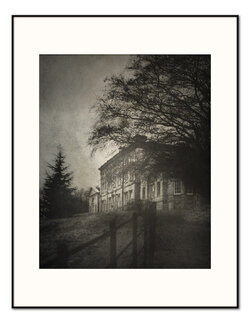
Cusworth Hall Doncaster Paper Negative

that is just stunning


This is my al time favourite of your pics. The technique is impeccable, the subject classic, with mood and all the right ingredients
WELL done!!
 
Ian, I am puzzled, perhaps you could explain how these fun processes add to our knowledge of Black and White photography. In a way,, and the same applies to pin-hole photography, it is going backwards. Yes, the results are interesting and do have merit but how do they help me and others like me who are digitally bound, to improve our processing methods and technique?

Norman
 
Simon likes it!

I wasn't/am not so sure. I like it much more when I forget about it being a photograph and imagine that I am looking at a lithograph. It then becomes outstanding!
 
Ian, I am puzzled, perhaps you could explain how these fun processes add to our knowledge of Black and White photography. In a way,, and the same applies to pin-hole photography, it is going backwards. Yes, the results are interesting and do have merit but how do they help me and others like me who are digitally bound, to improve our processing methods and technique?

Norman

Norman this is not aimed directly at you though I have tried to give an understanding why we do what we do.

Would you say in this day and age that reading a paper book or riding a bike or lighting a coal fire is going backwards?, you are right about it being fun however it’s all serious stuff with hours of practice not only in taking also in technique of development, this applies also to pinhole, or any other analogue photographic process

How does it help others, well I think a good start would be to ask questions about the process, how do we meter, how do we compose, how do we adjust film and paper speeds to suit and deal with reciprocity, one must remember that film is not dead, digital capture is a choice, but not the only one.

I edit my film pictures in much the same way I always did and do, Ian will do the same with scanned paper negatives, so my question is how it does differ to Digital capture, you still have to edit the file as we do. if one has such a desire to be creative then the easy way is not always the best, if you like what you see then it’s not beyond most people’s skill level to do the same, it’s all about how deep your interest and willingness to learn and to go another direction and pull yourself from the easy convenience of modern digital cameras, (not that there is anything wrong with that).

My pinholes and Ian’s paper negatives are just another way of creating a picture, being creative, no difference to editing any digital file, the only difference is the process to get there, and at the end of the day hopefully inspire others to try it, and after all it’s all black and white photography.
 
Martin, I have no chance of doing what you and Ian are doing because my move was from the darkroom to digital which I have not yet come to terms with and probably never will.

Norman
 
Martin,
What is a paper negative and how do you achieve this?
Regards,
Alan
 
Martin, I have no chance of doing what you and Ian are doing because my move was from the darkroom to digital which I have not yet come to terms with and probably never will.

Norman
Martin,
What is a paper negative and how do you achieve this?
Regards,
Alan
You take a picture onto photographic darkroom paper rather than film, develop the paper in a tray which will be a negative of the subject you have photographed, two ways to go now, either do a contact print again onto darkroom paper to make a positive image, or as Ian does scan it and invert to a positive.

There is more to it than this as there are problems to overcome such as paper iso for exposure and controlling paper contrast. That's the basic idea and workflow, however, I am sure Ian would clarify any points you may have as he has spent hours working at this process.
 
Martin, I have no chance of doing what you and Ian are doing because my move was from the darkroom to digital which I have not yet come to terms with and probably never will.

Norman
Norman I can well understand where you're coming from, I am no computer boffin by any stretch of the imagination but I do enjoy trying something different if at all possible.
 
Martin,
What is a paper negative and how do you achieve this?
Regards,
Alan

Martin has outlined the principle. You are not just restricted to 5x4, you could cut some paper to match either a medium or 35mm camera.
Unlike film, the paper is sensitive to blue light which is why you see many images with white skies.

The paper also has a variable speed, the speed in sunlight is going to be different to that in shade and also winter / summer can change the ISO value depending on how much blue light there is outside. For these cloudy days, I am exposing it at ISO 4.

Contrast range is another factor, the paper only has a contrast range of around 3 - 31/2 stops. To control contrast, I am trying different methods such as using a yellow filter to cut down the blue light and pre-flashing the paper by exposing it briefly to white light to add some density to it before the final exposure.

Developing is done in an open tray with paper developer. Because the paper is not sensitive to red light, this means I can leave the safe light on and watch the print emerge. I then snatch the paper from the developer when I feel there is enough density. (not an easy task especially under a very dim red light)
 
Seems lots of permutations to experiment with, should keep the participants interested for quite a long time...
The results a beautiful by the way....it's taking photography into the realms of art and picture making....
 
Ian, I am puzzled, perhaps you could explain how these fun processes add to our knowledge of Black and White photography. In a way,, and the same applies to pin-hole photography, it is going backwards. Yes, the results are interesting and do have merit but how do they help me and others like me who are digitally bound, to improve our processing methods and technique?

Norman

I am not sure the developing side has any baring on digital but after the negative has left the scanner, the image enters the digital darkroom just the same as a photograph captured on a digital device. From there on, dodging and burning is applied.

The actual picture taking process can be applied to digital, especially if the camera has a built in spot metering function whereby one moves tones around through metering. I appreciate with digital, the most information is obtained when exposing to the right but we do not always have to follow this, the important thing is to understand what will happen if we move away from these boundaries.
 
Ian, I am puzzled, perhaps you could explain how these fun processes add to our knowledge of Black and White photography. In a way,, and the same applies to pin-hole photography, it is going backwards. Yes, the results are interesting and do have merit but how do they help me and others like me who are digitally bound, to improve our processing methods and technique?

Norman

It'll about visualisation, style and inspiration Norman, more important than and separate from any technique old or new
 
While the explained technique is beyond me, I appreciate the nostalgic, somewhat moody feel to the image with the fence leading in on a diagonal. Composition is something I struggle with so I am always studying how people compose their image.
 
While the explained technique is beyond me, I appreciate the nostalgic, somewhat moody feel to the image with the fence leading in on a diagonal. Composition is something I struggle with so I am always studying how people compose their image.

The ONE thing that made the biggest difference to me understanding composition was not looking through the Viewfinder

by that I don't mean looking at the LCD but rather looking AT the viewfinder not through it. |

I realised the trouble with my struggling wit composition was because by looking through the VF I was not actually viewing it as a 2D flat plane but rathe as a 3D image, which a print can never convey as it is a flat plane
Now to compose and helped by the luxury of autofocus, I squint at the VF and very consciously realise I am putting a frame around what I select
This is one reason I think the old Leica users were so good at composing it was because they literally have a frame in the VF to place things in

Kind of like the idea of "fill the frame" with what you want to take a picture of? Not sure I am following you.....
 
Kind of like the idea of "fill the frame" with what you want to take a picture of? Not sure I am following you.....
not quite...
just being very conscious of the frame and whats in it, if you squint so you just see the larger shapes and tones it changes what you think is important to have in the frame when you can't see the details
 
Back
Top