
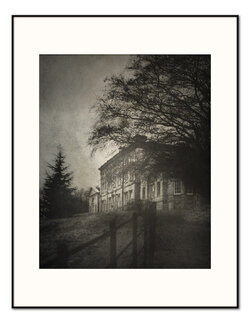
Ilford RC Paper
0.5 Second Post Flash
2 Second exposure @ ISO 4
Developed by Inspection


Ian, I am puzzled, perhaps you could explain how these fun processes add to our knowledge of Black and White photography. In a way,, and the same applies to pin-hole photography, it is going backwards. Yes, the results are interesting and do have merit but how do they help me and others like me who are digitally bound, to improve our processing methods and technique?
Norman
Martin, I have no chance of doing what you and Ian are doing because my move was from the darkroom to digital which I have not yet come to terms with and probably never will.
Norman
You take a picture onto photographic darkroom paper rather than film, develop the paper in a tray which will be a negative of the subject you have photographed, two ways to go now, either do a contact print again onto darkroom paper to make a positive image, or as Ian does scan it and invert to a positive.Martin,
What is a paper negative and how do you achieve this?
Regards,
Alan
Norman I can well understand where you're coming from, I am no computer boffin by any stretch of the imagination but I do enjoy trying something different if at all possible.Martin, I have no chance of doing what you and Ian are doing because my move was from the darkroom to digital which I have not yet come to terms with and probably never will.
Norman
Martin,
What is a paper negative and how do you achieve this?
Regards,
Alan
Ian, I am puzzled, perhaps you could explain how these fun processes add to our knowledge of Black and White photography. In a way,, and the same applies to pin-hole photography, it is going backwards. Yes, the results are interesting and do have merit but how do they help me and others like me who are digitally bound, to improve our processing methods and technique?
Norman
While the explained technique is beyond me, I appreciate the nostalgic, somewhat moody feel to the image with the fence leading in on a diagonal. Composition is something I struggle with so I am always studying how people compose their image.

The ONE thing that made the biggest difference to me understanding composition was not looking through the Viewfinder
by that I don't mean looking at the LCD but rather looking AT the viewfinder not through it. |
I realised the trouble with my struggling wit composition was because by looking through the VF I was not actually viewing it as a 2D flat plane but rathe as a 3D image, which a print can never convey as it is a flat plane
Now to compose and helped by the luxury of autofocus, I squint at the VF and very consciously realise I am putting a frame around what I select
This is one reason I think the old Leica users were so good at composing it was because they literally have a frame in the VF to place things in
not quite...Kind of like the idea of "fill the frame" with what you want to take a picture of? Not sure I am following you.....
