


Birkenau was constructed in the winter of 1941-42, initially as a vast prisoner-of-war complex. By the time it opened in March 1942 the Wannsee Conference deciding the final solution had taken place, and it became the central facility in what was referred to as a 'zone of interest', an area of 40km/sq containing some 40 sub-camps in which forced labour carried out factory and agricultural work and coal mining. Construction at Birkenau continued until late 1944 when the advancing Russians brought about the abandonment of the camp, and eventually covered some 350 acres sub-divided into 4 sectors by 16km of electrified barbed wire, containing in total around 300 accommodation and administrative barracks and buildings. Two farmhouses just outside the wire were initially converted into rudimentary gas chambers, but in mid-1942 construction began on four purpose-built gas chambers and crematoria nominally capable of 'processing' 1.6 million people a year. In May 1944 a railway spur was brought into the camp, from which detainees, the vast majority of them Jewish, were detrained onto the so-called 'ramp', in reality a strip of gravel between the sidings, and either selected to go to the barracks for labour details, or directed straight to the gas chambers. Of the 1.1 million people killed at the Auschwitz complex, 1 million were killed here, of whom some 900,000 were Jewish.
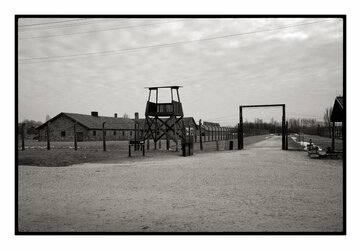
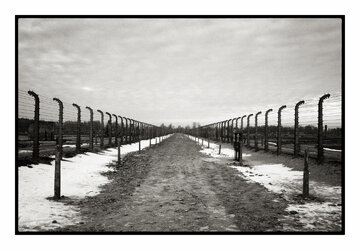
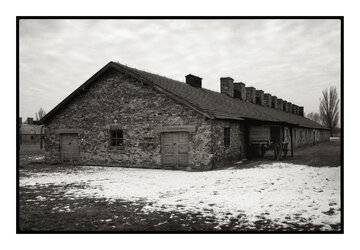
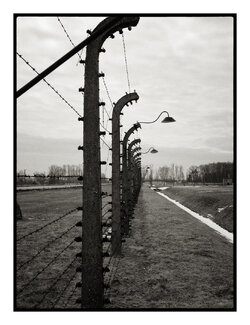
Much of the ground infrastructure at Birkenau has been preserved as a memorial; the external and internal barbed wire fences, drainage ditches, the watchtowers, the railway tracks and the entrance gate. Many of the brick-built barracks from the early phases of construction survive, though the wooden barracks from the later phases are long gone, leaving only foundations and stark brick chimney stacks. The gas chambers were blown up by the SS in late 1944 in an attempt to disguise the atrocities that had taken place here, but their haunting and blackened ruins remain in-situ. On the day on which we visited the temperature in the morning had been -18c; it was bitterly cold, with an icy wind blowing across the vast, flat site. I don't think I have ever felt so cold, despite layers of clothing, nor quite so numbed. It is surely the amongst the most God-forsaken and utterly miserable places on earth, but despite that, I'm glad that I went.



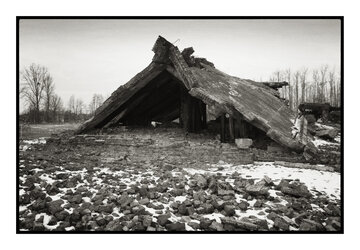
Much of the ground infrastructure at Birkenau has been preserved as a memorial; the external and internal barbed wire fences, drainage ditches, the watchtowers, the railway tracks and the entrance gate. Many of the brick-built barracks from the early phases of construction survive, though the wooden barracks from the later phases are long gone, leaving only foundations and stark brick chimney stacks. The gas chambers were blown up by the SS in late 1944 in an attempt to disguise the atrocities that had taken place here, but their haunting and blackened ruins remain in-situ. On the day on which we visited the temperature in the morning had been -18c; it was bitterly cold, with an icy wind blowing across the vast, flat site. I don't think I have ever felt so cold, despite layers of clothing, nor quite so numbed. It is surely the amongst the most God-forsaken and utterly miserable places on earth, but despite that, I'm glad that I went.
Last edited:


