

-
Thank You For Visiting... Please Click Here and sign up to contribute
You are using an out of date browser. It may not display this or other websites correctly.
You should upgrade or use an alternative browser.
Estuary Mud
- Thread starter John2
- Start date
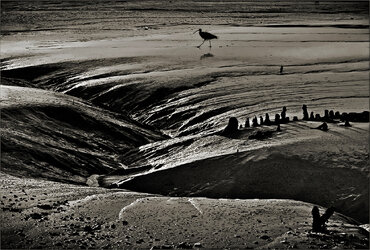

That mud looks familiar. Is it Sunderland point? If you crop the image to just below the bird and to the left of the ribs sticking out of the mud, not that I am saying you should, or even that it would better, the image, without a sense of scale, is suddenly transformed into a landscape of a river valley. Just saying.


I'm struggling with this; the surface of the mud looks as though it was reflective to the point of being burned out, and has been 'filled in' by dropping the tone in processing. My apologies if I'm wrong, it just doesn't quite gel.

Thanks Toby. It's a straight forward contra joure shot. The tonal range is huge and in anticipation, I would have exposed more towards the highlights and probably lifted the shadows in post. There may be some burning in here and there but I don't remember. What about the other aspects. Does the comp and idea appeal?
Not wildly, to be honest, but these things are very subjective; lots of other forum members do like it, and you can't please all the people etc... But that apart, processing glitches always get in the way for me. I know that you strongly feel that your audience should see through processing or upload shortcomings to the concept and compo of the image, but I just can't - to me if the image has unnecessary and avoidable technical faults, it fails as an image. If it wouldn't stand up to being printed, mounted, framed and hung, or published in a physical entity, then it doesn't work.Thanks Toby. It's a straight forward contra joure shot. The tonal range is huge and in anticipation, I would have exposed more towards the highlights and probably lifted the shadows in post. There may be some burning in here and there but I don't remember. What about the other aspects. Does the comp and idea appeal?
Not really so Toby. Comments on processing are very valid it's just that when that's all there is, the response is a bit disappointing. I always value your input Toby so please keep it coming.....................................I know that you strongly feel that your audience should see through processing or upload shortcomings to the concept and compo of the image, but .................................................
Last edited:

You ask me to make my point again. When the processing gets in the way, it gets in the way. When it's down to plain bad processing, or solvable technical issues, it's all there is. I might be happy to concede that there's a good image in there, but I can't see it because of the processing.Not really so Toby. Comments on processing are very valid it's just that when that's all there is, the response is a bit disappointing. I always value your input Toby so please keep it coming.
Then the problem might be with you Toby. The thing is Toby, I don't always see the problem you describe. Wet mud reflects. Low contra joure light accentuates contrast and texture. What are you viewing these images on. I have asked you this before but you have never responded. I'd be the first to admit that I'm not the best processor. Joanna in particular has helped me iron out one or two problems by being constructive in her comments. But to describe the above image as having resulted from plain bad processing or solvable technical issues is just over the top. You clearly have a different viewpoint to which you are entitled but being more constructive and less aggressive in your comments would lend more weight to them.
Last edited:
I'm sorry if I offend you, John, I don't mean to. The problem I find is that I've mentioned this issue so many times, but I feel you just brush it off. I did set out that it looked to be as though the mid-tones on the surface of the mud looked to me as though they had been created rather than were actually there in the original file. If that's the case, it might actually look better as a more graphic photograph, allowing the burned out areas to remain such.Then the problem might be with you Toby. The thing is Toby, I don't always see the problem you describe. Wet mud reflects. Low contra joure light accentuates contrast and texture. What are you viewing these images on. I have asked you this before but you have never responded. I'd be the first to admit that I'm not the best processor. Joanna in particular has helped me iron out one or two problems by being constructive in her comments. But to describe the above image as having resulted from plain bad processing or solvable technical issues is just over the top. You clearly have a different viewpoint to which you are entitled but being more constructive and less aggressive in your comments would lend more weight them.
Why not upload a copy of the original colour tiff merely converted to jpeg and resized appropriately, but without any other pp, it might help make things clearer?
I'm viewing on two different calibrated PC screens, both a decade old, but high res and of good quality. I also see your posts on my phone.
Last edited:
Low contre-jour light does indeed reflect, and on wet mud it is very likely to burn out on the reflective areas, and throw deep or solid shadows between them. It will thus accentuate contrast, but not texture. This is particularly so with digital sensors. Your photograph shows tone on those areas of the surface of the mud that I would expect to be burned out.Then the problem might be with you Toby. The thing is Toby, I don't always see the problem you describe. Wet mud reflects. Low contra joure light accentuates contrast and texture. What are you viewing these images on. I have asked you this before but you have never responded. I'd be the first to admit that I'm not the best processor. Joanna in particular has helped me iron out one or two problems by being constructive in her comments. But to describe the above image as having resulted from plain bad processing or solvable technical issues is just over the top. You clearly have a different viewpoint to which you are entitled but being more constructive and less aggressive in your comments would lend more weight them.
One of the many on line photo tutorials. Something I've always known even when I still used a film camera:
If you photograph a flat, textured surface with front lighting, you’ll produce an image of the flat surface without any real depth – the surface will look smooth. But if you photograph the same textured surface with a light positioned at a low angle and off to one side, the texture will become apparent. Why? Because the viewer will see the shadows created by the side light!
10 year old screens and your phone? I'm not going to continue this discussion Toby.
When should you use side light?
Side lighting is great when you want to emphasize texture or add a sense of depth to an image.If you photograph a flat, textured surface with front lighting, you’ll produce an image of the flat surface without any real depth – the surface will look smooth. But if you photograph the same textured surface with a light positioned at a low angle and off to one side, the texture will become apparent. Why? Because the viewer will see the shadows created by the side light!
10 year old screens and your phone? I'm not going to continue this discussion Toby.

This is where I have to promote DxO's tools. They include four sliders for Fine Contrast, Global, Highlights, Midtones and shadows.Low contre-jour light does indeed reflect, and on wet mud it is very likely to burn out on the reflective areas, and throw deep or solid shadows between them. It will thus accentuate contrast, but not texture
There is also the Smart Lighting tool, which acts like a Black Point, White Point and Tonal equaliser. All you do is mark the highlights and shadows and it works out an optimised Tone Curve between them.
I'll look for one of my images, similar to John's if you'd like.
So, we hit that wall again, where you cut the conversation off and there's no progress.One of the many on line photo tutorials. Something I've always known even when I still used a film camera:
When should you use side light?
Side lighting is great when you want to emphasize texture or add a sense of depth to an image.
If you photograph a flat, textured surface with front lighting, you’ll produce an image of the flat surface without any real depth – the surface will look smooth. But if you photograph the same textured surface with a light positioned at a low angle and off to one side, the texture will become apparent. Why? Because the viewer will see the shadows created by the side light!
10 year old screens and your phone? I'm not going to continue this discussion Toby.
My PC screens are more than fine. I use them to generate exhibition and sale-ready prints. This is just a silly excuse.
Perhaps Helen might come in here, as you seem prepared to listen to her.
Oh, cross post, Helen's already here.