

-
Thank You For Visiting... Please Click Here and sign up to contribute
You are using an out of date browser. It may not display this or other websites correctly.
You should upgrade or use an alternative browser.
You should upgrade or use an alternative browser.
Converting Colour To Black And White
- Thread starter ian barber
- Start date

This is getting far to technical for me. I think I will retreat into my darkroom and print B&W. No need for any conversion.
Indeed. There is no need to get into all this stuff about comparing conversion processes.
However, don't forget that darkroom printing is still a conversion - from negative to positive. And you have to consider dodging and burning, using multigrade paper and filters, varying development times, etc.
"Real" darkroom printers can often spend hours working out a printing plan, making test strips, etc. I know of one master printer who wouldn't think anything of making 27 exposures on a single image, just to get the tonalities just right.
As I've intimated before, I use DxO PhotoLab with FilmPack integrated. All I do is select the film of my choice and use tone, contrast, channel mixer, etc to give me the best appearance on screen - then just print using my Canon 1000 Pro's in-built B&W printing mode. Average time to process a simple B&W - less than an hour.
The results must be good - I've just sold two of the images I put into our club's exhibition.

Indeed. There is no need to get into all this stuff about comparing conversion processes.
However, don't forget that darkroom printing is still a conversion - from negative to positive. And you have to consider dodging and burning, using multigrade paper and filters, varying development times, etc.
Yes I cannot disagree with you, but any manipulation done in a darkroom with silver gelatine prints is by the printers actual skill. knowledge and judgement. I cannot be bothered with sitting at a desk for hours at end, in front of a screen using technology from someone else's computer programme I do as much as I need to and that is enough for me. I do photography to have some enjoyment not to wear out sets of worry beads.
… any manipulation done in a darkroom with silver gelatine prints is by the printers actual skill. knowledge and judgement.
I really hope you are not implying that the work I (and others) do in digital photo processing doesn't involve skill, knowledge and judgement? I bring all my darkroom processing skills to bear on any and every image I process and, sometimes processing might be quick and easy, because I use the appropriate tools. Yet other times, it may take just as long to process digitally as it does to create a complex wet print with dodging and burning.
I cannot be bothered with sitting at a desk for hours at end, in front of a screen using technology from someone else's computer programme
Instead, you use the technology that you have learnt from myriads of other photographers - unless you only do simple printing.
I do as much as I need to and that is enough for me
So do I. And I don't have to clean up all those dishes afterwards.
I do photography to have some enjoyment not to wear out sets of worry beads
So do I. And, once I have taken the time and effort to create a print, I know that I don't have to start all over again like I would with wet printing. Instead, I can just run another print and get on with enjoying more creative photography.
Just a quick example of where digital printing is exactly the same as wet printing, is when you get an image that you have to physically print several times before getting the perfect rendering on paper.
Obviously, nobody has taken the time and effort to explain to you how easy digital post-processing can be - which is not surprising if all you have read about is the Adobe tool chain, where there are other, much easier to use apps out there.
Last edited:

I am sure no offense was intended, perhaps a step back and a deep breath before responding might help the blood pressure ! Offense can be found in all sorts of places if we are determined to interpret it as such.I really hope you are not implying that the work I (and others) do in digital photo processing doesn't involve skill, knowledge and judgement? I bring all my darkroom processing skills to bear on any and every image I process and, sometimes processing might be quick and easy, because I use the appropriate tools. Yet other times, it may take just as long to process digitally as it does to create a complex wet print with dodging and burning.
The Adobe tool chain is simpler, easier, cheaper and more appropriate for many many people who have voted with their feet (and subscriptions).
Tribal rebelliousness whether is Nikon vs Canon, Adobe vs Capture One ( or dxo / other underdog ) etc etc is really a distraction from creating great images which can be done very well with any solution available in the last 10 years. Does a fraction less noise in the shadows change the important aspect of an image to other than those determined to pixel peep. Incremental marketing spin from competing providers needs some heavy filtering.

I’ve not tried GIMP GEGL c2g so can’t comment on it but you’ve got me interested in it now!thank you both for your replies, Joanna and stevenz - very nice picture, Joanna !
you know in my question i try to focus mainly on one topic, a technicality, which is to compare local/focal vs global data processing methods, for example in this context of color to gray conversion. i myself worked for years in image processing and i am well aware about focal contrast nuances that may or may not deserve to be looked at or addressed or perhaps even enhanced via a given technique. that's why i am so intrigued by this relatively old algorithm implemented in the GIMP GEGL c2g code that does its enhancements locally but universally applied, carving out beautiful gray scale images that often reveal more detail than what desaturation techniques can offer.
i am aware that new software for photographic image processing make silently use of all kind of 'AI' driven solutions which come closer to the idea of locally or rather regionally altering signal intensities - though they begin, for my taste at least, to alter image content and hence create new realities which is not what i speak about here.
anyway, this is an old topic of mine and i am just trying to find the right club to advance with theses questions and answers and to do test comparisons. i tried such at the l-leica-forum but felt a bit left alone. perhaps i am just not aware of all the new goodies modern commercial software do offer ?
Though I know nowt about it I actually find it rather interestingin any case, i am new to this forum and don't intend to bore folks to death with such technicalities right from the start - so, i am going to sieve a bit through older posts here and see what has been discussed in this area.
I suppose that’s because it suggests the possibility to me of achieving something different to what’s possible ( for me with my simple skills) to do something other than what’s achievable with the programs I currently use namely Lightroom and very occasionally photoshop.
Joanna mentioned red filter effects: this is something which I’ve never found to produce results on skies anything like a real red filter with film, at least not without introducing artifacts etc
Reading this thread with great interest…
If you don’t find it interesting why comment?In around 20 years of digital photography I have turned out stunning B&W prints without having ever resorted to all this ancient trickery. I do wonder why you are bothering, unless it's for purely research purposes, or do you think this will give you better prints?
There is so much more to B&W conversion than simply crunching the numbers. Which is why I leave it to the genii at DxO to provide tools that make it possible to turn out stunning images in minutes without ever leaving the RAW file.

I'm new to this forum and as simultaneously ignorant and appreciative of black and white photography as I am of Vivaldi and Ligetti. These discussions remind me of similar discussions relating to the virtues of analog (vinyl) and digital. I was once firmly convinced of the superiority of digital until I came to hear the difference between my analog recording of George Szell's Shubert's Ninth and the digital disc mastering. My untrained eye still finds any digital rendering of a black and white (with the exception of Leica's monochrom) to have the same problems and the analog/digital divide on sound recordings.I am sure no offense was intended, perhaps a step back and a deep breath before responding might help the blood pressure ! Offense can be found in all sorts of places if we are determined to interpret it as such.
The Adobe tool chain is simpler, easier, cheaper and more appropriate for many many people who have voted with their feet (and subscriptions).
Tribal rebelliousness whether is Nikon vs Canon, Adobe vs Capture One ( or dxo / other underdog ) etc etc is really a distraction from creating great images which can be done very well with any solution available in the last 10 years. Does a fraction less noise in the shadows change the important aspect of an image to other than those determined to pixel peep. Incremental marketing spin from competing providers needs some heavy filtering.

A mentor of mine designed analogue circuits for television sets and in his spare time like to tinker with audio. TV, recording tape, 78s and LPs: he worked on them all, squeezing the best performance out of every component and system.
When CDs came along he was an early adopter. "Perfect sound for ever" had been promised.
His 25th anniversary with the company was fast approaching and, as was the custom, his work mates wanted to make something for the occasion. We scratched our heads for ages and eventually the penny dropped. What was the inveterate tinkerer to do now that everything was perfect? There was nothing left to tweak.
So we made a special piece of equipment that plugged into his CD player to put back the bangs, whirs and whistles. There was a control each for hum, wow, flutter, distortion, bandwidth restriction, noise, stuck groove, a gramophone spring winding down and even an absence control which did absolutely nothing except to be used by those with golden ears who could hear the difference between a cheap and an expensive mains plug.
On the day of the presentation we smuggled his own HiFi system onto the stage and connected in our piece of whizz-bangerry. He was over the moon. Mission accomplished.
I guess, in a way, it was a precursor to LUTs, film emulations and pre-sets. We should have patented it.
When CDs came along he was an early adopter. "Perfect sound for ever" had been promised.
His 25th anniversary with the company was fast approaching and, as was the custom, his work mates wanted to make something for the occasion. We scratched our heads for ages and eventually the penny dropped. What was the inveterate tinkerer to do now that everything was perfect? There was nothing left to tweak.
So we made a special piece of equipment that plugged into his CD player to put back the bangs, whirs and whistles. There was a control each for hum, wow, flutter, distortion, bandwidth restriction, noise, stuck groove, a gramophone spring winding down and even an absence control which did absolutely nothing except to be used by those with golden ears who could hear the difference between a cheap and an expensive mains plug.
On the day of the presentation we smuggled his own HiFi system onto the stage and connected in our piece of whizz-bangerry. He was over the moon. Mission accomplished.
I guess, in a way, it was a precursor to LUTs, film emulations and pre-sets. We should have patented it.
Last edited:
Instead, you use the technology that you have learnt from myriads of other photographers - unless you only do simple printing.
I may have learned some of the techniques from others but mostly it came from my experience in the darkroom and reading about it Where I had made mistakes that is where you learn and that learning sticks. You could pretty well say much the same as learning to be a cabinet maker or a blacksmith or a metal turner you learn from others, but overtime you develop your own skill and what you produce is from your own personal skill, learned over the years not using a programme composed by some techie who composes the various essential software. What can be simpler than setting up a printer to do the printing hard work for you.
I would much prefer to own a piece of hand made furniture than to buy an IKEA flatpack, because whilst they are functional where is the skill in assembling a ready made kit (Apart from deciphering the instructional drawings) they always look what they are - inexpensive and factory made. Wielding a screwdriver or an Allen Key can hardly be classed as a skill.
Now that gave me a good laugh. ThanksA mentor of mine designed analogue circuits for television sets and in his spare time like to tinker with audio. TV, recording tape, 78s and LPs: he worked on them all, squeezing the best performance out of every component and system.
When CDs came along he was an early adopter. "Perfect sound for ever" had been promised.
His 25th anniversary with the company was fast approaching and, as was the custom, his work mates wanted to make something for the occasion. We scratched our heads for ages and eventually the penny dropped. What was the inveterate tinkerer to do now that everything was perfect? There was nothing left to tweak.
So we made a special piece of equipment that plugged into his CD player to put back the bangs, whirs and whistles. There was a control each for hum, wow, flutter, distortion, bandwidth restriction, noise, stuck groove, a gramophone spring winding down and even an absence control which did absolutely nothing except to be used by those with golden ears who could hear the difference between a cheap and an expensive mains plug.
On the day of the presentation we smuggled his own HiFi system onto the stage and connected in our piece of whizz-bangerry. He was over the moon. Mission accomplished.
I guess, in a way, it was a precursor to LUTs, film emulations and pre-sets. We should have patented it.
I started off doing color darkroom before trying BW, I shot weddings and did my own developing and printing at first, untill I could not cope with demand. I had no idea when I first started what I was doing, there was no internet then to find out info, I had to learn by mistakes and reading books. I am no master in the darkroom but I do it now for pleasure and fun. I tend to do it in winter time now because my room I use for my darkroom faces the sun all day and with it blacked out its like a steam room.
But I also like the digital process as well, still learning on that side.
But I also like the digital process as well, still learning on that side.
I worked in a hi-fi shop in the early 70s and met folks who were part of the desperate search for audio perfection. Rumble filters, suspended turntables, anti-skid compensation arms, etc. Why? Because they were trying to get rid of all the imperfections that the then current technology gave them.These discussions remind me of similar discussions relating to the virtues of analog (vinyl) and digital. I was once firmly convinced of the superiority of digital until I came to hear the difference between my analog recording of George Szell's Shubert's Ninth and the digital disc mastering
Then came CDs and the self-same folks who would spend inordinate sums on obtaining a "clean" sound then started to moan that digital was "too clean"! Such folks were also guilty of buying gold-plated connectors in order to purify the sound, even though digital sound is totally impervious to analogue irregularities. There really was no pleasing some people.
So, now we have the same analogy when it comes to photography. Analogue work involves trying to get rid of imperfections like dust spots, scratched film, coping with high dynamic range, especially with colour slide film with its limited dynamic range. Of course colour slides needed folks to huddle around a nice warm projector with a reflective screen that was full of imperfections to best appreciate the results. Black and white film, although having more dynamic range, still needed special care, possibly using the Zone system to compress 14 or more stops of range into the 8 stops of photographic paper. The hours spent in the darkroom, followed by the hours spent spotting the print, all of which had to be reproduced when someone asked for another print. But the sense of achievement when we finally arrived at the "perfect" print - even though, if you looked at it from certain angles under certain lights, you could see the spotting marks.
Then, finally, came digital cameras, although the early ones were fairly rudimentary with sensors that didn't really give much better results than film, in terms of resolution and noise or grain? But the perpetual complainers then forgot that grain, although sometimes interesting artistically, was a severe limitation on how large a print they could make out of a 35mm negative and started to complain that digital noise (also known as digital grain) was getting in the way of their otherwise perfect images. So they then started to demand software that reduced or, even better, eradicated noise.
I still have and, occasionally, use my LF film camera but, since my 46Mpx Nikon can produce every bit as good an image as my Mamiya RZ67, MF film work has just become arduous when I can get the same enlargement size with the Nikon.
Yes, I love the feel of my Mamiya 7II and the glorious "ker-slap" of the mirror in the RZ67 but maybe that's just part of the nostalgia that meks me forget that it was hard work getting the best out of a negative. Or maybe it is because it is "hard work" that we feel that sense of satisfaction at the final result.
The inference of those who are so anti-digital or pro-analogue seems to be that digital is easier and, by implication, not worthy of the same accolades that some heap on the the "craft" of analogue prints.
Well, I can assure you, after years of perfecting digital techniques, that digital, done properly and well, is far from easy or quick.
It is about time that those who criticise digital work realise that, without digitising their negs or prints, nobody on these forums would ever get to see their work. One of the most common faults I see in photos shared on this forum is over-sharpening, resulting in "crunchy" images. then there's the fact that, in order to get the same contrast levels, in a paper image, on a monitor, it is necessary to expand the dynamic range to match that of a backlit screen.
Finally, if I take a digital image and send it to Ilford for printing on their Lambda printer, on silver halide paper, is it still a digital image, or does the analogue paper change that? All I know is that I have never come across anyone, who does not know its history, that can tell me it is not an analogue print just by looking at it, even with a magnifying glass.
Let's do a deal - I won't criticise your amazing analogue skills, which I fully comprehend from my own experience, whilst you cease from criticising the hard learned digital skills of those of us who have sweat blood and tears to achieve the same results.
Now there's a can of worms.... Finally, if I take a digital image and send it to Ilford for printing on their Lambda printer, on silver halide paper, is it still a digital image, or does the analogue paper change that? ...
It could be argued that film photography is not strictly analogue. Individual crystals of metallic silver grow according to the amount of light received which gives rise to the various tones of a photograph. The crystals are quite separate and seen as "grain". This is, in effect, a process of quantisation like the one a digital camera sensor uses to convert light into pixels.
Similarly with analogue TV. The electron beam of an old cathode ray tube scans the screen left to right, and then left to right a little further down, and again and again until it reaches the bottom of the screen. Think of it like reading a a book. As such, the signal is analogue in the horizontal direction but quantised in the vertical direction. In other words it is a hybrid of both analogue and digital. The persistence of the phosphor on the back of the screen allows the eye to see the whole frame as a complete image.
The point I am trying to make is that the distinction between analogue and digital is not as clear cut as people think.
As you have said.
With regards to the Ilford process, that would be a digital print but the characteristics of the emulsion present the image differently from the inks used in a normal printing process. As to whether that gives a better visual result I leave the reader to decide.
Last edited:

I don't believe that it's the process that's important. For me, the ultimate objective of any aspect of photography is to make a satisfying image which in turn, others may (or may not) appreciate. The less I have to do and the more easily I can achieve that has to be the way forward.
In its history, photography has always pursued those aims. Its's a story of technical innovation in terms of both mechanical and chemical improvements aimed at making the job easier which in turn has allowed the broadening of horizons. Digital is just a continuation of that process. However, the commercial considerations of professionals apart, to the rest of us it's a pastime to be enjoyed. Just as with HiFi, that enjoyment can come in many forms which include not just making images but amongst others, using legacy equipment and processes or even just pride of ownership of the latest equipment. In other words, each to his own and we shouldn't characterise any one aspect as being better or worse than another. So I am fully behind Joanna's deal because it respects that view.
As for over sharpening Joanna (and Toby), - noted.
In its history, photography has always pursued those aims. Its's a story of technical innovation in terms of both mechanical and chemical improvements aimed at making the job easier which in turn has allowed the broadening of horizons. Digital is just a continuation of that process. However, the commercial considerations of professionals apart, to the rest of us it's a pastime to be enjoyed. Just as with HiFi, that enjoyment can come in many forms which include not just making images but amongst others, using legacy equipment and processes or even just pride of ownership of the latest equipment. In other words, each to his own and we shouldn't characterise any one aspect as being better or worse than another. So I am fully behind Joanna's deal because it respects that view.
As for over sharpening Joanna (and Toby), - noted.
After reading your illuminating commentary I realize that I am expecting the camera to make up for my shortcomings. I expect to have done in-camera what I ought to be doing creatively after I press the shutter.I worked in a hi-fi shop in the early 70s and met folks who were part of the desperate search for audio perfection. Rumble filters, suspended turntables, anti-skid compensation arms, etc. Why? Because they were trying to get rid of all the imperfections that the then current technology gave them.
Then came CDs and the self-same folks who would spend inordinate sums on obtaining a "clean" sound then started to moan that digital was "too clean"! Such folks were also guilty of buying gold-plated connectors in order to purify the sound, even though digital sound is totally impervious to analogue irregularities. There really was no pleasing some people.
So, now we have the same analogy when it comes to photography. Analogue work involves trying to get rid of imperfections like dust spots, scratched film, coping with high dynamic range, especially with colour slide film with its limited dynamic range. Of course colour slides needed folks to huddle around a nice warm projector with a reflective screen that was full of imperfections to best appreciate the results. Black and white film, although having more dynamic range, still needed special care, possibly using the Zone system to compress 14 or more stops of range into the 8 stops of photographic paper. The hours spent in the darkroom, followed by the hours spent spotting the print, all of which had to be reproduced when someone asked for another print. But the sense of achievement when we finally arrived at the "perfect" print - even though, if you looked at it from certain angles under certain lights, you could see the spotting marks.
Then, finally, came digital cameras, although the early ones were fairly rudimentary with sensors that didn't really give much better results than film, in terms of resolution and noise or grain? But the perpetual complainers then forgot that grain, although sometimes interesting artistically, was a severe limitation on how large a print they could make out of a 35mm negative and started to complain that digital noise (also known as digital grain) was getting in the way of their otherwise perfect images. So they then started to demand software that reduced or, even better, eradicated noise.
I still have and, occasionally, use my LF film camera but, since my 46Mpx Nikon can produce every bit as good an image as my Mamiya RZ67, MF film work has just become arduous when I can get the same enlargement size with the Nikon.
Yes, I love the feel of my Mamiya 7II and the glorious "ker-slap" of the mirror in the RZ67 but maybe that's just part of the nostalgia that meks me forget that it was hard work getting the best out of a negative. Or maybe it is because it is "hard work" that we feel that sense of satisfaction at the final result.
The inference of those who are so anti-digital or pro-analogue seems to be that digital is easier and, by implication, not worthy of the same accolades that some heap on the the "craft" of analogue prints.
Well, I can assure you, after years of perfecting digital techniques, that digital, done properly and well, is far from easy or quick.
It is about time that those who criticise digital work realise that, without digitising their negs or prints, nobody on these forums would ever get to see their work. One of the most common faults I see in photos shared on this forum is over-sharpening, resulting in "crunchy" images. then there's the fact that, in order to get the same contrast levels, in a paper image, on a monitor, it is necessary to expand the dynamic range to match that of a backlit screen.
Finally, if I take a digital image and send it to Ilford for printing on their Lambda printer, on silver halide paper, is it still a digital image, or does the analogue paper change that? All I know is that I have never come across anyone, who does not know its history, that can tell me it is not an analogue print just by looking at it, even with a magnifying glass.
Let's do a deal - I won't criticise your amazing analogue skills, which I fully comprehend from my own experience, whilst you cease from criticising the hard learned digital skills of those of us who have sweat blood and tears to achieve the same results.
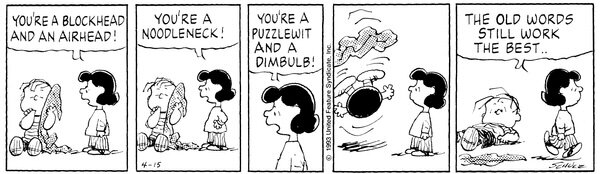
There may be a bit of the Luddite in me. I have gone back and looked and old photos and have been reworking many of them based upon suggestions I've read here, fruitfully in many ways. Perhaps I'm like Lucy in the old Peanuts comic strip:
Attachments
I would rather it wasn't referred to as 'analogue' It is not the term I would use. Film photography is a term that says it all and needs no other description or interpretation and as such it cannot be miss-represented.Now there's a can of worms.
It could be argued that film photography is not strictly analogue. Individual crystals of metallic silver grow according to the amount of light received which gives rise to the various tones of a photograph. The crystals are quite separate and seen as "grain". This is, in effect, a process of quantisation like the one a digital camera sensor uses to convert light into pixels.
I am not saying one is overall better than the other it is just that I get far more satisfaction from film although for convenience I do use it occasionally and of course we have to 'lower'
myself to scan something to send a picture by E mail.
Last edited:
Me too.I would rather it wasn't referred to as 'analogue' It is not the term I would use. Film photography is a term that says it all and needs no other description or interpretation and as such it cannot be miss-represented.
The trouble is that analogue has become the default description for that which is not digital without an understanding of what those two terms mean. Analogue good, digital bad. Digital good, analogue bad. Actually both have their advantages and disadvantages. And as you rightly point out, some things are neither one nor the other despite their popular descriptions. Vive la différence.
It's the way language evolves unfortunately. No point fighting it.
Last edited: