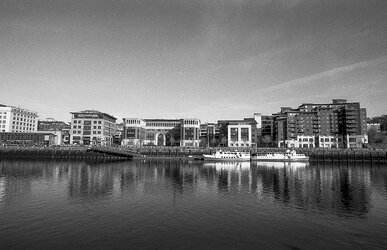
The still waters of the River Tyne

John King

Well-Known Member
Registered
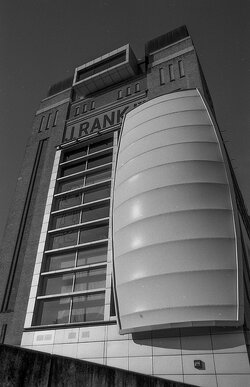
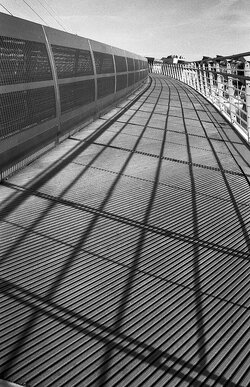
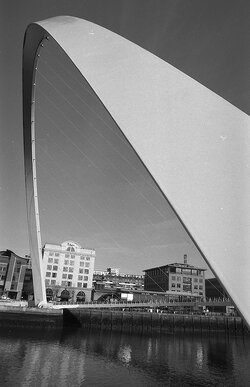
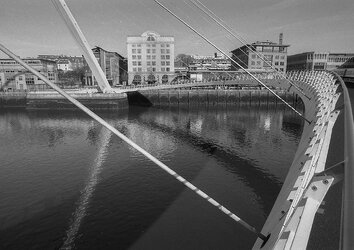
These were part of 2 rolls of Kentmere 100 put through my F6 during a mornings walk along the banks of the Tyne back in 2015 going to visit the Sunday open market on the north side of the river. Very little wind and virtually no cloud to speak of in early spring.

No1. The Newcastle side of the river from the south bank.
No2. The old Rank Flour mill which is on the south bank now part of the 'Sage'.
No3. The rising footway over the Tyne on the Millennium Bridge also known and the 'Blinking Eye'.
No4. The suspension 'Bow' that supports the walkway that tilts to let ships up the river
N05. The walkway over the river with the suspension cables.
No6. From the middle of the walkway looking up stream showing the 7 bridges the cross the river between Gateshead and Newcastle. The furthest ones will not be discernible in the picture but the all are:- The Millenium Bridge, (you can just see the top of the suspension 'bow), The Tyne bridge (Road), King Edward Bridge (railway), Armstrong's Hydraulic Swing Bridge, (Road) The Tyneside Metro Bridge (rail), Stevensons High Level Bridge (road and train), and finally The Reheugh Bridge (road).

The next crossing is about 3 miles further on with the A1 Western Bypass to Edinburgh.
 

Attachments

  • 01.jpg
    01.jpg
    567.8 KB · Views: 23
  • 02.jpg
    02.jpg
    478.6 KB · Views: 21
  • 03.jpg
    03.jpg
    723.3 KB · Views: 20
  • 04.jpg
    04.jpg
    484.7 KB · Views: 20
  • 05.jpg
    05.jpg
    580.9 KB · Views: 23
  • 06.jpg
    06.jpg
    509.6 KB · Views: 23
These are pleasing record shots, John, I particularly like the second.

What happened to your spotting brush?:oops:

There seems to be a lot of grain for a 100asa film?
 
Last edited:
These are pleasing record shots, John, I particularly like the second.

What happened to your spotting brush?:oops:

There seems to be a lot of grain for a 100asa film?
They were a direct scan from B&W B&W negs which will account for the grain. I could have used the grain reduction facility but that would have eroded the sharpness of the image which I prefer over mushy images. As for the spots minute as they are I was working on my laptop and the small screen did mot really make them obvious to me. No excuse I know but there you are.

The large ugly Sage building was built more or less on a derelict site where in the 19th C once stood one of the largest gunpowder factories in the country, For reasons not satisfactorily explained it blew up and also cased serious damage on the north side of the river. It is said that the only building that did not suffer serious damage was the Medieval castle Keep
 
Last edited:
I like number five best. But I agree with Toby. For100 iso, the film does look rather grainy. And you need to get spotting John.
What film developer did you use?
 
I like number five best. But I agree with Toby. For100 iso, the film does look rather grainy. And you need to get spotting John.
What film developer did you use?
Developed in my normal ID11 diluted 1-1 @ 68f. If I were to print these to A4 or even a little larger onto Ilford MG paper then scan them the grain is nigh on invisible. I hold my hands up for the spotting, but what there was to me was almost invisible on the scans.

If you look back a couple of weeks, or possibly 3, I posted a set called Industrial Workhorses. These were taken with with the same film, same developer, same temp, same dilution and same developing time. But then printed onto Ilford MG to A4 Size which were then scanned (as I described above). The grain on these is invisible. It is the scanner that creates or emphasises the grain when an intermediate hard silver print is not used. Not my technique.

As I mentioned above, I could have used a grain reducing button but that also softens the whole image. I prefer a little grain not overall slightly unsharp prints.
 
Last edited:
John, I'm guessing you are using a proper film scanner, not a flatbed scanner. When I used to use a Nikon 35mm film scanner I used to get grain on the digital print that was more visible than the grain on a darkroom print from the same negative. The Nikon film scanner produced good sharpness, but seemed to emphasise the grain. I'm guessing that this is what is happening to you.
When my Nikon film scanner broke I started scanning 35mm negatives on an Epson V700 flatbed scanner (which I had previously only used for medium and large format negatives) This doesn't emphasise grain. My digital prints from Epson V700 scans are equal in grain to darkroom prints done from the same negatives.
I'm not saying the flatbed scanner is better. The Nikon scanner seemed to produce a level of micro-contrast that looked good in the print. And anyway, I quite like grain. Just putting a few thoughts out for consideration....
 
I too like a little bit of grain when making a picture with film, but not so with digital. That is a 'me thing'! What is there about a flatbed that is not a 'proper scanner'? I do own a Nikon scanner (Coolscan 5) which is away to a repairer in Lincolnshire. It was well overdue for a clean and lube and the scans were not as good as they were when it was newer-15 yrs ago!

So I used my V600 which is not a bad scanner as a flatbed goes. Actually at the present I am digitising my estimate of 10,000+ negs from the past 35+ years to make the finding a particular image easier, and as it is so much quicker than the Coolscan. So when it was still set up I used one of these negative sheets rescanned at a 300ppi but the final image was set at the largest pre-set, then shrunk down to 1080ppi for uploading which is as near as dammit the same format as A4

Actually digital leaves me unemotional, - a tool with no soul. Possibly because I have so little input to the final result, but it has it's quick fix uses. I take far more care with silver prints.
 
Last edited:
As I understand it, the Coolscans are known to accentuate grain.

I think in this instance I was a bit surprised at the size of the grain for a 100 asa film, even scanned. I've never used Kentmere.
 
Kentmere film does tend to be a bit grainier than say FP4+ and a whole lot more so than Ilford Delta but not nearly as coarse as Foma 100&200
 
Back
Top