

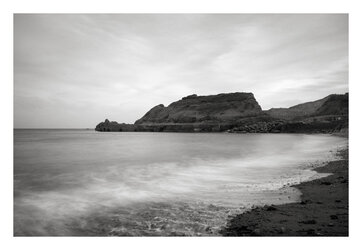
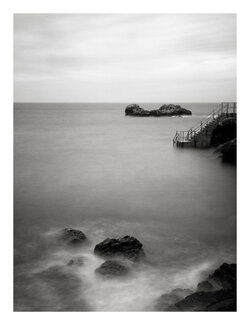
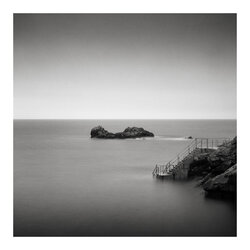
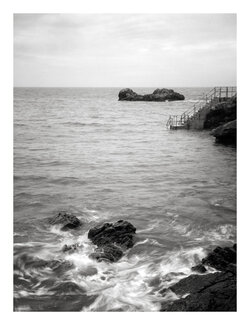
Post-industrial and old military sites on the south Cornish coast.
Nikon D7200/Nikkor 17-55 f2.8/Lee 10 Stop ND

I think I would like to try it with crowds although a ten stop might be overkill. I was looking at some old pics taken with an early digital camera whose ISO was really slow and a mild subject movement adds something IMO. Easy to overdo though.

There sure is. Re read John Kings post, he was talking multiple exposures without filters. The other method is to take photos really late in the evening after the Sun has set, in the blue hour, and when it it getting towards dark see my post Le Diben - Evening Tide. I didn't use a filter for this.is there any alternative to nd filters if you dont own any,all i have is a cokin s and a couple of grad filters.
JB
It has been a long time since I made long exposures like these and the way I did them was quite different to these. We had the Late Les Maclean give us a talk at our club which at that time was in West Sussex on this subject, where he used long exposures and the way he did them was after assessing the normal exposure which shall I say would be around 1 second at F16 using his Mamiya C330f he would make 60x exposures at F16, each of 1/60th of a second plus and occasional 10% extra to take a care of reciprocal failure depending on the quality of light. The end result was not all that different, but there was a certain aesthetic appearance which made them stand out from a comparative exposure using a single 1 second exposure.
There was also a difference if he photographed the same scene using his 55mm wide angle 80mm standard or the 180mm telephoto. Les said his biggest problem was if it was taken on a sandy beach (and we have a lot of them on the Northumberland coast) he had to take care that his tripod legs didn't sink into the sand between the first and last exposure!
I tried this method and had minor success but not to the standard that he had perfected it. (He was also a far better printer than I could ever be.) Of course the C330 had a manual re-cocking of the shutter which meant he could take hundreds of repetitive short exposures if and whenever he wanted to.

I seem to remember that one of my Nikons had this multiple exposure approach built in to the exposure options but I can't say that I ever used it. The advantage of the approach is also that it avoids the colour cast that many ND filters impart. Not a problem in mono I know. As to the sinking tripod. I have the same problem on Blackpool beach but I take three small plant pot saucers with me to place under the tripod legs and that seems to solve the problem.It has been a long time since I made long exposures like these and the way I did them was quite different to these. We had the Late Les Maclean give us a talk at our club which at that time was in West Sussex on this subject, where he used long exposures and the way he did them was after assessing the normal exposure which shall I say would be around 1 second at F16 using his Mamiya C330f he would make 60x exposures at F16, each of 1/60th of a second plus and occasional 10% extra to take a care of reciprocal failure depending on the quality of light. The end result was not all that different, but there was a certain aesthetic appearance which made them stand out from a comparative exposure using a single 1 second exposure.
There was also a difference if he photographed the same scene using his 55mm wide angle 80mm standard or the 180mm telephoto. Les said his biggest problem was if it was taken on a sandy beach (and we have a lot of them on the Northumberland coast) he had to take care that his tripod legs didn't sink into the sand between the first and last exposure!
I tried this method and had minor success but not to the standard that he had perfected it. (He was also a far better printer than I could ever be.) Of course the C330 had a manual re-cocking of the shutter which meant he could take hundreds of repetitive short exposures if and whenever he wanted to.

I found his web page on-line: https://williamarnold.net/William-ArnoldI viewed an exhibition by a talented young Cornish photographer called William Arnold the other day. One of his past projects was photographing various Cornish beaches in August using 90 minute exposures. The concept was interesting, but I can't say that I loved the results, they were somewhat 'muddy'.

Sounds interesting. I have seen something similar using digital cameras although 60 large files would likely be too much to process at once. They are full length exposures too so the effect would be different. Might give it a go with one of my analogue cameras though. Hmmm. Food for thought. I'll put it in the project book.... We had the Late Les Maclean give us a talk at our club which at that time was in West Sussex on this subject, where he used long exposures and the way he did them was after assessing the normal exposure which shall I say would be around 1 second at F16 using his Mamiya C330f he would make 60x exposures at F16, each of 1/60th of a second ...
is there any alternative to nd filters if you dont own any,all i have is a cokin s and a couple of grad filters.
JB
I think you have misunderstood. There would not be 60 large files but one file where there had been 60 exposures taken one after another. I am not sure that modern cameras can make as many as 60 multiple exposures on one frame. I may be wrong but I have not heard of one.Sounds interesting. I have seen something similar using digital cameras although 60 large files would likely be too much to process at once. They are full length exposures too so the effect would be different. Might give it a go with one of my analogue cameras though. Hmmm. Food for thought. I'll put it in the project book.

I am not sure that modern cameras can make as many as 60 multiple exposures on one frame. I may be wrong but I have not heard of one.
Actually I do understand the concept John but quite possibly didn't explain myself very well.I think you have misunderstood. There would not be 60 large files but one file where there had been 60 exposures taken one after another. I am not sure that modern cameras can make as many as 60 multiple exposures on one frame. I may be wrong but I have not heard of one.
