I'm ashamed ....

Keith Haithwaite

Well-Known Member
Registered
....of myself. :eek: A Stuck at Home project is to tidy up my workshop and lurking in a dark corner was this set of tools wrapped in an old cloth, obviously not cleaned when I last used them some thirty years ago. :mad: Not to miss a photo opportunity I did this quick shot with my P&S camera and processed on my old Windows laptop.

Tools like this will probably never be used again and full marks to anyone who knows what they are and what they were primarily used for. Hint: There are two subtle clues, one in the text and one in the image. Answers on a postcard ....................
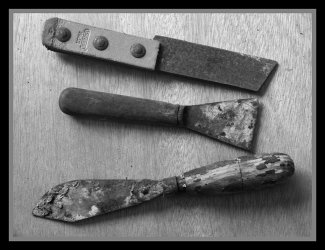
Tools_Framed.jpg
 
Perhaps it's almost easy. The third tool in this set of window glaziers tools is a chopping knife, used with a hammer to 'chop out' all the old solidified putty, glass and sprags from the frame rebate, the small scraper was then used to follow on and clean it up prior to preparing it for fitting the new glass. I was taught how to use these when Noah was a lad along with the secrets of replacing broken sash window cords & weights - skills that command a premium rate today for use in some of the old houses that are being 'up marketed'.
 
You beat me to it Keith. I still have the putty knife and used to have the scraper and believe it or not I knew the chopping knife. I come from a long line of carpenters and wheelwrights and like you used them all when Noah was a lad.
 
I agree with what you say. The Knife here in West Yorkshire was called a `Hacking Knife. ` Used as you have described. On starting my apprenticeship in the Plumbing industry. I was presented with all the tools shown in your picture on the 2nd day of my employment. Then I was sent with a Plumber to start replacing broken windows in a run down Hotel in Scarborough. My rate of pay was 6 old pence per hour. In those days we had to catch the bus. This was from Vicar lane in Leeds to Scarborough. We found lodgings.We were there for about 4 weeks . In December 1946. Not very pleasant.
Nokin.
 
Thanks a lot - not!

I had conveniently forgotten about the untidy state of my garage/workshop. It is tidier than it was when I was swapping the gearbox on one of my motorcycles, but it is gradually getting back to where it will have to have some serious attention. The problem is I have a lot of stuff/junk to throw out, some quite bulky and the recycling centre is closed. I may have a problem!
 
Thanks for refreshing my dodgy memory Nokin, Hacking Knife it is (don't know where the chopping knife came from, cross-corruption across memory cells methinks). Nokin, if memory serves, the tradesman as I recall used an old worn-smooth 10" flat file held flat against the glass for tapping in the sprags, does this ring a bell with you?
 
The knife at the top (if that is what it is) reminds me of a home made knife my father put together with a wooden handle just after the war when it was cheaper to mend your shoes yourself than take it to a cobblers. The wood, I have no idea what it was but the blade was made out of a strip of very very hard steel about 1/16"thick which he ground down to make an exceedingly sharp blade to cut the leather. It was so hard the knife would do all the cutting to resole a pair of his work boots before it needed sharpening again.

Talking of which, the stone he used was the same size as modern sharpening stones but the actual material had a much fine grain than the ones you can buy from a tool shop today. I have tried to find another but the same kind of material does not seem to be used anymore. The blade after being ground on the stone was 'stropped' against my grandfathers coal miner's leather belt. That way he removed any rough bits on the cutting edge It was so sharp he could shave the hairs in his arm and this was his test to see if it was sharp enough.
 
Last edited:
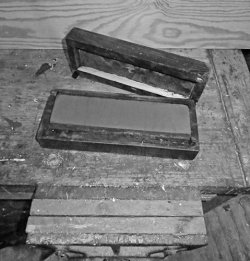
I believe the stones you refer to John are what I have always known as 'oil stones' and were lubricated with a drop of lamp oil. I have this one in a home-made box, given to me some thirty years ago. To my knowledge it is at least eighty years old, still going strong and sharpens my chisels and plane irons regularly. The texture is so fine it feels very much akin to slate. The black lines across the surface are pencil lines, used as indicators to tell you that you are using the full width of the stone. A final hone on plate glass with a little chrome polish brings an edge far sharper than a razor blade.

Whetstone.jpg
 
That sounds very much like it was the oil stone. It was lubricated when he used it but I cannot remember what it was. For all I know it may have been a bit of lard left over from her cooking. I wonder why you don't seem to be able to get them now? Or are they sold under a different name? I do know the stone that is sold to sharpen blades now is comparatively coarse and no where so good.
 
Looking at my stone under a high powered magnifier John there is just a hint of stratification so I'm wondering if it is cut from some kind of shale. I know oil and gas is extracted from shale so perhaps the clue is in the name - oil stone! I dunno but it's been an interesting discussion, thanks.
 
Since the last post I have been on't web and it seems that it is actually a man made material called silicon carbide. This was previously known as carborundum and is possibly the hardest man made material. I cannot find a stockist where I can buy a block for sharpening chisel and plane blades in the UK. They seem to be quite normally available in America. The price difference is significant between the stone(?) we can get here and the ones in America with those being about 3 times the price. Silicon carbide is available here but only as grindstones for bench grinders, but they are coarse grit, the finest being about 120grit. The block stone you have can be anywhere from 2000 to 4000 grit.

It also seems the term 'oil stone' comes from the treatment before being used is to soak it in a dish containing a thin oil for up to 7 days before use.
 
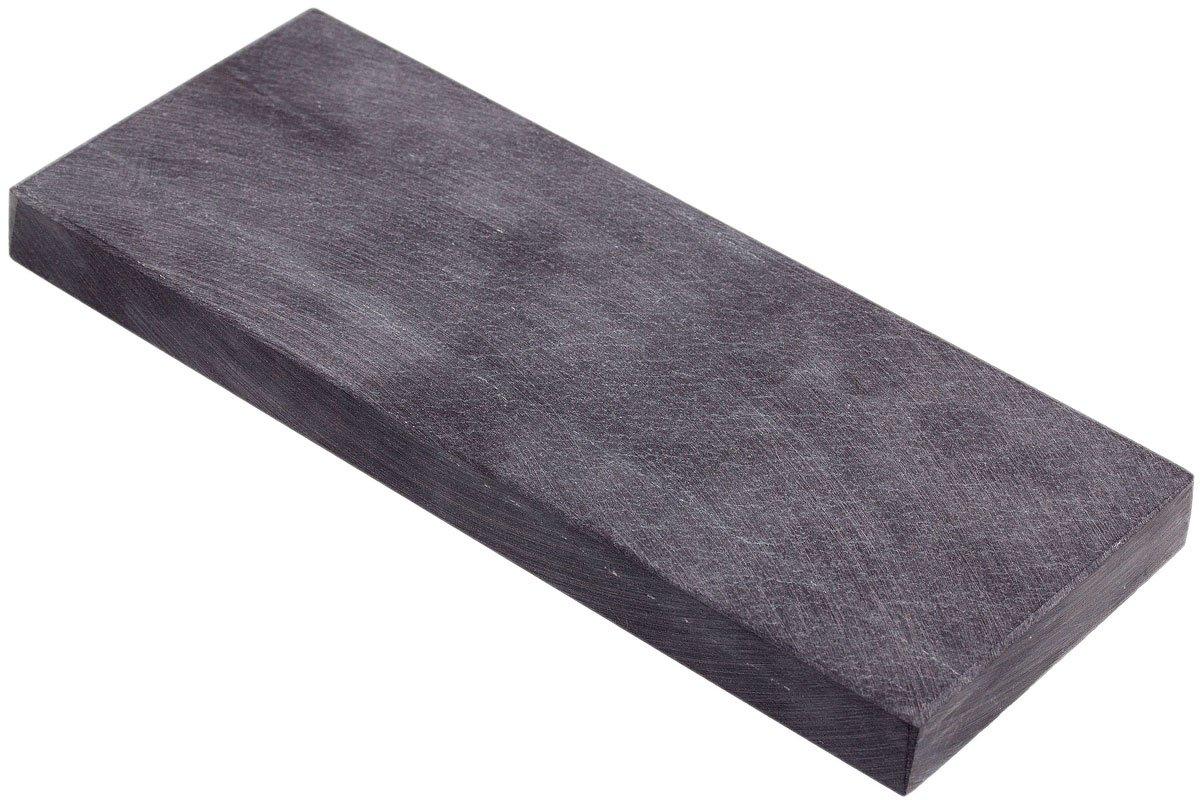
I would never have guessed that mine was man made, thanks for doing the research John. Out of curiosity I searched for natural whet stones available in the UK and found a whole range of materials, grits and prices - thankfully I'll never have to buy one. This one surprised me, made out of garnet of all things.
 
Not sure why you can't find anything in the UK John. At the cheap end Screwfix sell a silicon carbide sharpening stone for chisels etc for £5. For the finer grits as you mention chef's suppliers sell whetstones with grits of 1000/3000 but at a price, think nearer £40. They also do a range from 240/800 to 3000/8000. Have a look here https://www.mychefknives.co.uk/794-sharpening-stones
 
Keith as I mentioned the stones easily available are too coarse grained for what I have in mind (I Have 2 already and they do not rear well) and want one of the very fine grain type. There is a post after your last one which I have not looked at yet and this has a link to what I was seeking.

I have just looked at the previous post and they are probably what I have been after. The other, cheaper ones have in a very short time developed a very slight concave surface. where the material had worn away and give a very poor, slightly curved cutting edge to a plane blade. I would expect to pay more for a better quality item so I think I will get in touch with them.
 
The knife at the top (if that is what it is) reminds me of a home made knife my father put together with a wooden handle just after the war when it was cheaper to mend your shoes yourself than take it to a cobblers. The wood, I have no idea what it was but the blade was made out of a strip of very very hard steel about 1/16"thick which he ground down to make an exceedingly sharp blade to cut the leather. It was so hard the knife would do all the cutting to resole a pair of his work boots before it needed sharpening again.

Talking of which, the stone he used was the same size as modern sharpening stones but the actual material had a much fine grain than the ones you can buy from a tool shop today. I have tried to find another but the same kind of material does not seem to be used anymore. The blade after being ground on the stone was 'stropped' against my grandfathers coal miner's leather belt. That way he removed any rough bits on the cutting edge It was so sharp he could shave the hairs in his arm and this was his test to see if it was sharp enough.
Re the `Hacking- Knife.` The handle was two strips of leather riveted to the Steel Blade. As for the oil sharpening stone I have seen them incorporate two grades of stone, One side was course, and turn it over and you had a finer grade have you tried this yet.?
Nokin.
 
Back
Top