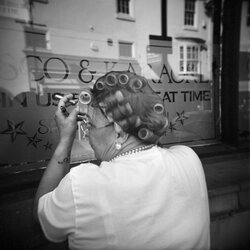
Doncaster Street Candid

And a hairnet too. :)

This is a real 'blast' from the past. I remember my mam wearing curlers like that. And you often used to see women in the street with them too. But don't recall seeing it for years. Is Doncaster in a time warp?:)

The actual image is great, close enough in (for me) to have interest, great subject - social interest, textures, the lot.
 
PS do you have a view on getting permission for stuff like this Ian.

Personally I'm inclined to either make it obvious that I am taking a picture, or overtly getting some kind of acceptance that it is ok.

But the type of camera seems to be a big factor, and I would guess that a Holga would raise few exceptions wheras my Olympus with a massive standard lens on it would raise complaints.

Certainly when I have taken candid shots with my phone nobody bat an eyelid.
 
Chris,

Excellent post. My question about his intent was along the same line.

This is so unlike anything I've seen Ian do. To me this is true street photography with lots of cultural pieces and social ramifications. It may be a "snappy" shot with no social intent. Unfortunately there wasn't a phone involved. That would mean it's good.
 
PS do you have a view on getting permission for stuff like this Ian.
My personal view is that it is often easier to ask forgiveness than permission. Often, asking permission before the shot means you don't get the same natural feel to the "pose" that people subconsciously adopt when they know they are going to be photographed.

In this particular case, the face is neither fully visible nor recognisable, so I wouldn't have bothered - published and be damned! (as the saying goes) :p
 
Good point Joanna.
I'm against the invasion of privacy. One example I've seen, on this forum, is to photography people eating at a restaurant. without knowing Sneaky photography is in poor taste.
 
Actually, the law in the UK is that you are allowed to take photos of someone in a public place without their express consent. Obviously that shouldn't extend to anything that would demean the person, but that should be a matter of common sense.

Anyhow, on this forum, we should be amongst friends and most participants are unlikely to abuse that privilege.

Don't forget, with all our modern day sensitivities, that if we don't take such pictures, the world of the future will never have the pictorial social history that we are privileged to see from past times.
 
Not sure Joe what by sneaky photography but much/most street photography is candid and done without permission. It's the type I prefer. If you mean photography which in some way abuses a person in a vulnerable situation then that's something I would be uncomfortable with. It's important to me to give dignity to a subject.
 
I'm with you Mark. It's about preserving individual integrity. This is a tough one to define. But I know it when I see it. I'm sure you do also.
 
Everyone has to decide what they are comfortable with. I'm interested in what that range might cover.

E.g. taking pictures without permission might be acceptable to photographer A if they are overt about actually taking the picture. Whereas they might not be ok about holding the camera loosely at (say) waist height and secretly taking shots.

But photographer B might be ok with the secret method.

Personally I am in the A person camp.
 
E.g. taking pictures without permission might be acceptable to photographer A if they are overt about actually taking the picture. Whereas they might not be ok about holding the camera loosely at (say) waist height and secretly taking shots.

If it's a candid shot of someone, as in, they don't know their being photographed, what's the difference? In either case, the subject is unaware that you are photographing them?. Are you saying that subjects should always know that you are photographing them? In the pictures of yours', with people in them, did you first ask them if you could take their picture? Did you ask after?

If you're in camp A do you mean as a picture taker or approval or disapproval of the way others take pictures? I ask because I've seen a picture of yours that I've liked with people in them, and I wonder if they knew you were photographing them. If not what difference does it make where you hold your camera?

In this clip, is HCB being overt or secretive?

Is the documentarian who made this documentary, in which we see HCB at work, and if he'd not made it, we'd never see HCB working, which camp is the documentarian in?

I'd like to know what you mean, Chris?
 
if we don't take such pictures, the world of the future will never have the pictorial social history that we are privileged to see from past times.

Yes. One of the pioneers of fine art photography and in B&W, Paul Strand. HIs work is iconic. This on his candid photography:

"One of his cleverest innovations came in the mid-1910s in the course of his early efforts to capture an objective, realistic record of life on the bustling New York streets.

In order to catch people in totally candid states, Strand attached a false lens to his camera that lay perpendicular to the real one. While he would appear to passersby to aim the camera in one direction, he would conceal the actual lens under his arm, allowing for stealth portraits of unguarded subjects.

The resulting photos captured honest slices of the angst and moodiness of urban life that were a photographic rarity in Strand’s time."

As it always the case, the work speaks for itself: https://mashable.com/2016/07/08/paul-strand-new-york-portraits/?europe=true

Thank you, Joanna.
 
Hmm, this lot is making me think a bit harder/clearer.

Re A ... I am saying I personally tend to being in camp A. Other folk might well come to a different conclusion and that is fine.

I suppose that, for me, my starting point is that people should be aware that the photographer is taking pictures and be in a position to object.

There is also the practical problem of someone realising that someone is taking secret pictures of them and objecting with physical violence.

Using a false lens deliberately to mislead people would not be for me but, again, that is for the individual photographer to decide.

Interesting stuff this; i like a bit of theoretical/morals discussion every so often, and this is all helping me to get my thoughts clear :)
 
Ps ... 'the work speaks for itself'

is possibly another way of saying

'the end justifies the means'

and that has been a topic of disagreement for years (I think:))
 
I am saying I personally tend to being in camp A. Other folk might well come to a different conclusion and that is fine.

Thanks for the answer and clarification, Chris. Don't know if you watched the HCB stuff but it amazes me to watch him work!
 
Back
Top