Quite correct John, contact Ian, not me, to send you the tickets, now here's the story;
The Bramhope tunnel
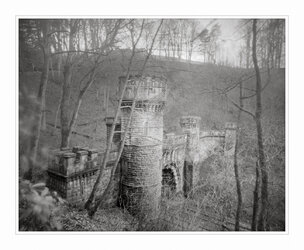
Two sighting towers were first built for the surveyors to keep the line true, then from 20 October 1845 twenty shafts were sunk to enable tunnelling, after the tunnel was completed four shafts retained for ventilation. The shaft north of Otley Road is 240 feet deep, the one behind Park House is 239 feet, Camp House Farm 204 feet and the one nearest to Horsforth station is 175 feet deep. The ventilation shafts measure 40 feet (12 m) by 30 feet (9.1 m) – wider than the tunnel. The finished tunnel is 2 miles, 243 yds. or 2.138 miles (3.441 km) long; 25.5 feet (7.8 m) wide by 25 feet (7.6 m) high. It is a double track tunnel, with a gradient of 1 in 94 (0.01%). During its construction
Building the tunnel was dangerous because the rock at the Horsforth end was difficult to blast, and there was frequent flooding and subsidence. About 1,563,480,000 gallons (7,107,580,080 litres) of water were pumped out of the workings between 1845 and 1849. Metal sheets had to be used to divert water inside the tunnel.
Work was carried out by up to 2,300 navvies and 400 horses were brought in for the work. The workforce included 188 quarrymen 102 stone masons 732 tunnel men, 738 labourers and 18 carpenters. Each day around 2150 wagon loads of rock and earth was removed from the workings to be tipped on the Wharfe embankment leading to the Arthington Viaduct.
Men were lowered by bucket down the airshafts to dig by candle light. They were paid £1.50 per week to shovel 20 tons (20.32 tonnes) of rock and earth per 12–hour shift, seven days a week. Conditions were constantly wet, with foul air and gunpowder fumes and the danger of roof–collapse. The tunnel cuts through hard sandstone, shale and clay, and there are seven major faults in the rock near the centre point.
For four years the workmen, some of whom brought their families, lived in 300 temporary wooden bothies either in a field alongside the offices and workshops, or elsewhere along the line of the tunnel. Day and night shift workers lived up to 17 per hut taking turns to use the beds in unsanitary conditions Just try to imagine the conditions they endured.
Records of death and injury were kept from 1847 to 1849, and a special sprung handcart was provided to transport the injured to hospital.
Five men died in 1846, twelve died in 1847 and seven more had died by 1849. The 24 men who died are commemorated in Otley churchyard by a Grade II listed monument in the shape of the north portal It was erected by the contractor.
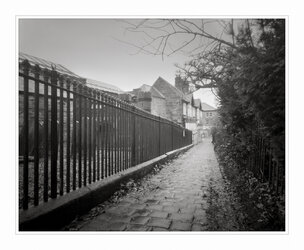
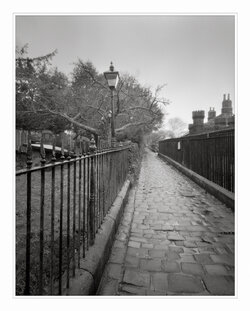
The tunnel commemoration can be seen in the last two pictures, the top picture is the Northern Portal to the tunnel, still in use today.