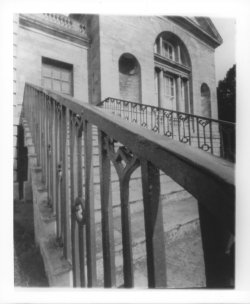
I wanted to test what ISO to use for a paper Pinhole project I shall be working on in the summer.
Rather than test individual frames, I decided to make a roll and use the ZeroImage 2000 Pinhole camera for the tests.
I cut some paper the width of MF 120 film, taped one end to a the spool, cut a leader and loaded it into the camera.
A few weeks ago, I had already measured and calculated the frame spacing so I was good there.
Field Tests
I went up to Cusworth Park then realised I had left the tripod in the house, not to worry, I will just plonk the camera down anywhere I could and point it at something.
ISO
From doing paper negatives on 5x4 I had a rough idea what the ISO should be but having never used this paper before which incidentally is Ilford Grade 1, I decided to use a combination of 3 values, ISO 4, ISO 8, ISO 12. It turned out that ISO 4 is the one I shall be using as this one seemed to give the best results.
Development
Development was easy because you can do it all under safe light conditions. I had some developer left over from last night so I poured that into a jug and brought it to 20 degrees. I loaded the roll of paper onto a 120 spool and placed it into the jug of developer, agitating one way and then the other for the full development time. Normal stop, Fix and wash followed the development.

I cut them into strips of 3 and did a very quick scan as a tiff file (no raw) and no post processing.
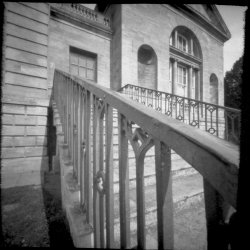


Rather than test individual frames, I decided to make a roll and use the ZeroImage 2000 Pinhole camera for the tests.
I cut some paper the width of MF 120 film, taped one end to a the spool, cut a leader and loaded it into the camera.
A few weeks ago, I had already measured and calculated the frame spacing so I was good there.
Field Tests
I went up to Cusworth Park then realised I had left the tripod in the house, not to worry, I will just plonk the camera down anywhere I could and point it at something.
ISO
From doing paper negatives on 5x4 I had a rough idea what the ISO should be but having never used this paper before which incidentally is Ilford Grade 1, I decided to use a combination of 3 values, ISO 4, ISO 8, ISO 12. It turned out that ISO 4 is the one I shall be using as this one seemed to give the best results.
Development
Development was easy because you can do it all under safe light conditions. I had some developer left over from last night so I poured that into a jug and brought it to 20 degrees. I loaded the roll of paper onto a 120 spool and placed it into the jug of developer, agitating one way and then the other for the full development time. Normal stop, Fix and wash followed the development.
I cut them into strips of 3 and did a very quick scan as a tiff file (no raw) and no post processing.
Last edited: