


-
Thank You For Visiting... Please Click Here and sign up to contribute
You are using an out of date browser. It may not display this or other websites correctly.
You should upgrade or use an alternative browser.
You should upgrade or use an alternative browser.
WOPPER [sic]
- Thread starter Digital Finger
- Start date
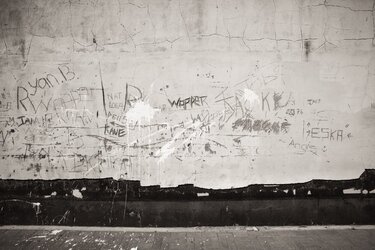

Really like this.
thanks José

looks like you're on your own
LOL
looks like you're on your own
LOL

Wall art, poor art, captured art, interesting
thanks José
looks like you're on your own
LOL
I like it a lot. It's honest.
Love the shot,
and now I'm going to be controversial -
There appears to be a convention, particularly among serious photographers, that to seat an image into the frame and draw the eye to elements within the image there has to be an element of 'edge burning'.
But why?
Sure in some cases the convention holds, but creatively I see no reason to present a 'flat canvas' edge to edge with no edge burning where the image speaks strongly across the frame. For me this particularly applies to 'pattern' and 'texture' shots, where I expect to see a 'flat canvas'.
Personally I think the wall is a strong canvas and an interesting pattern and there is no need for edge burning.
Just my personal opinion and 2 pennyworth.
Below is an abstract 'pattern shot' with no edge burning, because I don't think it needs it.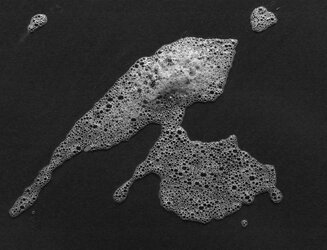
and now I'm going to be controversial -
There appears to be a convention, particularly among serious photographers, that to seat an image into the frame and draw the eye to elements within the image there has to be an element of 'edge burning'.
But why?
Sure in some cases the convention holds, but creatively I see no reason to present a 'flat canvas' edge to edge with no edge burning where the image speaks strongly across the frame. For me this particularly applies to 'pattern' and 'texture' shots, where I expect to see a 'flat canvas'.
Personally I think the wall is a strong canvas and an interesting pattern and there is no need for edge burning.
Just my personal opinion and 2 pennyworth.
Below is an abstract 'pattern shot' with no edge burning, because I don't think it needs it.
And here is a more pictorial shot where the subject of the boat is framed by the landscape and in my opinion requires no edge burning to draw the eye to the subject. The water bottom left alludes to the open sea and I know that convention would say it distracts the eye from the main subject, and there is a case for that argument. But my visualisation is that the water alludes to the infinite ocean from whence the boat came in its life and in 'death' it rests on a new plane of the solid earth...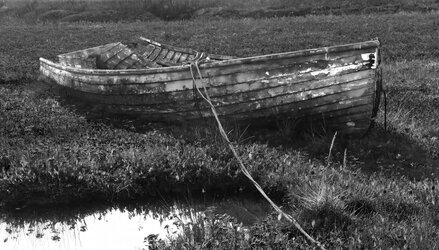
A
Alan Jones
Guest
The textures on the wood of the boat look a tad waxy to me...And here is a more pictorial shot where the subject of the boat is framed by the landscape and in my opinion requires no edge burning to draw the eye to the subject. The water bottom left alludes to the open sea and I know that convention would say it distracts the eye from the main subject, and there is a case for that argument. But my visualisation is that the water alludes to the infinite ocean from whence the boat came in its life and in 'death' it rests on a new plane of the solid earth...View attachment 9390
Love the shot,
and now I'm going to be controversial -
There appears to be a convention, particularly among serious photographers, that to seat an image into the frame and draw the eye to elements within the image there has to be an element of 'edge burning'.
But why?
Sure in some cases the convention holds, but creatively I see no reason to present a 'flat canvas' edge to edge with no edge burning where the image speaks strongly across the frame. For me this particularly applies to 'pattern' and 'texture' shots, where I expect to see a 'flat canvas'.
Personally I think the wall is a strong canvas and an interesting pattern and there is no need for edge burning.
Just my personal opinion and 2 pennyworth.
Below is an abstract 'pattern shot' with no edge burning, because I don't think it needs it.View attachment 9389
Thanks DG well I agree with you but some people seem to be better at getting it right than others , vignetting is still a dark art as far as I’m concerned, and I am a mere acolyte
Love the shot,
and now I'm going to be controversial -
There appears to be a convention, particularly among serious photographers, that to seat an image into the frame and draw the eye to elements within the image there has to be an element of 'edge burning'.
But why?
Sure in some cases the convention holds, but creatively I see no reason to present a 'flat canvas' edge to edge with no edge burning where the image speaks strongly across the frame. For me this particularly applies to 'pattern' and 'texture' shots, where I expect to see a 'flat canvas'.
Personally I think the wall is a strong canvas and an interesting pattern and there is no need for edge burning.
Just my personal opinion and 2 pennyworth.
Below is an abstract 'pattern shot' with no edge burning, because I don't think it needs it.View attachment 9389
Edge effects are a way of drawing the eye into a picture, it’s not a law or rule, it is purely a personal creative technique, I do agree that not all images need it, in fact, they can look worse with the wrong type of image, its only another visual tool at our disposal.
With some cameras, such as the Holga and Pinhole, and, older types of lens it's part of there signature look and charm.
There are no rights and wrongs in this photography game, anything goes as long as it plausible as photographic art, that's discounting digital art, which another ball game.
If you have not seen this short video, you might find it interesting seeing a shift in light can be creative.