The Slog (Beware: mental health warning for some viewers)

Elines

Well-Known Member
Registered
IMG_9591 The Slog v1 wip mounted.jpg

(The mental health warning is because I used AI in creating this image.)

Background to my thinking

Years ago I read something from Julia Anna Gospodarou which, as I recall, was along the lines of: 'Create what you want the world to be, not what it is'.

This struck a chord with me and maybe helps explain why I generally find (eg) landscapes of little interest. They tend to be pictures of what is there.

On another thread ?Toby (in talking about the 'unimportance' idea) referred to visiting London where there are taller buildings more suited to my aim.


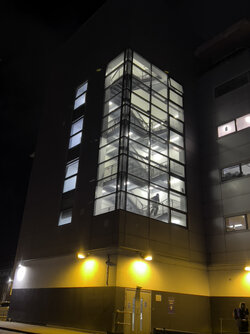
For this image I knew what I wanted to create (= a picture of someone having to walk up a load of stairs carrying a heavy weight). Problem was .... the building wasn't that high : see original

IMG_9591-Edit.jpg


So I used AI to make the building taller.

Given what I was trying to do, and that the amount of work I applied to get the the final image is way more than the few words needed to generate the taller building with AI, I think this is a reasonable (artistic) use of AI.

(Edit: in this image….) The use of AI may well be apparent in a print, but for web use seems ok - no doubt others will tell me otherwise if they disagree - and please feel free to comment freely and constructively :)
 
Last edited:
At risk of upsetting folk (not my intention), AI is here and, whatever we think, it is not going away.

When photography was introduced and started to impinge on the space the visual arts then occupied, art changed. It couldn't compete with the cost and speedy execution of a photographic portrait for example. Out of it came new kinds of art: impressionism, surrealism, abstraction and all schools of creative practice that led us where we are today. Photography and art both survived intact.

Perhaps then, photographers need to respond to AI in the same way. That doesn't mean the old skills disappear (take the recent resurgence in film photography for example) but they do have to change. In my view there is an adult discussion to be had about the positioning of AI and how it can help us creatively without cheating, and perhaps too about new directions our art needs to take.

Exciting times.

Nice pic by the way. I like the concept and the way your title amplifies it.
 
Last edited:
There is nothing wrong with AI. It is the people that (will) use it with evil intent that are the problem. Sadly, we're stuck with that.
 
My problem with AI is that it does not and cannot qualify as photography.

Wikipedia talks about the origin of the word…
Photography is the art, application, and practice of creating images by recording light, either electronically by means of an image sensor, or chemically by means of a light-sensitive material such as photographic film

The word "photography" was created from the Greek roots φωτός (phōtós), genitive of φῶς (phōs), "light" and γραφή (graphé) "representation by means of lines" or "drawing" ] together meaning "drawing with light".
AI images are not created from light, they are created from words. A better word would be logography.
 
Notwithstanding Joanna's important point, this is an effective image.

I quite like it that JG said that. It is particularly pertinent to the genre, and your use of AI sort of proves the point I made earlier.

I'll take you up on your summation of landscape photography as merely being a record 'of what's there' though; as soon as you've processed the original by dodging and burning, or by using alternative processes, indeed by presenting in B&W, it isn't. It's an interpretation, a vision presented on paper.
 
Last edited:
………

I'll take you up on your summation of landscape photography as merely being a record 'of what's there' though; as soon as you've processed the original by dodging and burning, or by using alternative processes, indeed by presenting in B&W, it isn't. It's an interpretation, a vision presented on paper.


Thanks for the compliment Toby.

Fair comment re landscapes.

I try to be clear in my mind on why I like or don’t like individual images and particular genres - so need to work on that: current reasoning sloppy :(
 
I'll take you up on your summation of landscape photography as merely being a record 'of what's there' though; as soon as you've processed the original by dodging and burning, or by using alternative processes, indeed by presenting in B&W, it isn't. It's an interpretation, a vision presented on paper

When we photograph landscape, it is rarely just as a record. In order to be attractive, it has to be a scene that has geometry, curves, leading lines, etc. More of a work of art. See our Flickr page.
 
My comment was about AI in general not just in the context of photography. However, is there an argument for AI's use in photographic tools as opposed to artificially created content. Even in the case of the latter, context might justify its use. An image created as an illustration of a situation in absence of a suitable straight photograph might be acceptable but if such an image is claimed to be an actual capture of a real subject, it might not.
 
Last edited:
I think it’s technically possible, in PS, to achieve increase in height by a mixture of copy/move/clone/transform tool (say).

So if I’d done it that way, ie without AI…..

Would you all be perfectly ok with that?

And if not, why not?

For me, in this case, AI was just the easiest way to achieve my objective.
 
So if I’d done it that way, ie without AI…..

Would you all be perfectly ok with that?

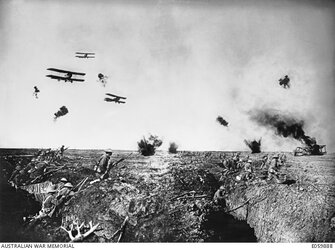
No problem at all. If you want to merge your photographs. You only have to think of Frank Hurley and his (in)famous composite war photograph…


4148458.JPG


The problem with generative AI is that it appropriates other peoples' images, without their permission.

Even Adobe's new AI erase tool takes other people's images to fill in what it thinks the background would have looked like, based on a vast database of other people's work.

As I said, my main beef is that generative AI creates images from textual or spoken inputs, not from what the "author" captured using light.

Call it what you will but, just as colour photos are not permitted in a B&W photography forum, B&W non-photos should equally not be acceptable.

Julia Anna Gospodarou talks about (en)Visionography and Photography Drawing - works based on her photographic images, sometimes heavily manipulated, but still her images. It's a bit of a clumsy word but, at least, it is based on an artist's original photos. Maybe, there needs to be another word for images made from other peoples' work.

In summary, my main objection is that generative AI is using other photogaphers' work without their consent or even acknowledgement.
For me, in this case, AI was just the easiest way to achieve my objective
Since when was photography meant to be easy? ;)
 
Last edited:
I'm with Joanna on this. We all use some AI when processing our images. But what I am against with generative AI is you just tell the AI software what you want then it produces the image for you. To my way of thinking it is like commissioning someone to take a photo for you, then claiming you took the image.
 
Thanks for your reply Joanna - very helpful
No problem at all. If you want to merge your photographs. You only have to think of Frank Hurley and his (in)famous composite war photograph…

...

OK - so adding something to a scene that wasn't actually there is not a problem - the issue is the source of the added bits. I'm ok with that But see below*.

......

Since when was photography meant to be easy? ;)

I'd say it is meant to be easy when you are learning/relearning something (as in my case on this occasion). Eg when learning how to add textures I think it's ok to use free ones off the internet. When you have learned how to use them, and want to continue, then - yes - you should create your own.

..........

The problem with generative AI is that it appropriates other peoples' images, without their permission.

Even Adobe's new AI erase tool takes other people's images to fill in what it thinks the background would have looked like, based on a vast database of other people's work.

As I said, my main beef is that generative AI creates images from textual or spoken inputs, not from what the "author" captured using light.

.....

This may be a moot point in my particular case - difficult to know because I don't know how the AI actually worked but ....

.... I think it's reasonable to say that *the extension is based on the lower half of the image - which is mine and captured from light. And that it is not based on a database of stolen images. However .... it is true to say that the adjacent 'windows' are from an unknown source - and if I'd thought I could have deleted them.

But my main point is that, for me, this was a training/learning effort (regarding realising a 'vision').

I'm with Joanna on this. We all use some AI when processing our images. But what I am against with generative AI is you just tell the AI software what you want then it produces the image for you. To my way of thinking it is like commissioning someone to take a photo for you, then claiming you took the image.

Thanks for your helpful comments too Helen.

I agree but I don't think my (declared) use of AI in this image is as extreme as in the case you suggest.

An analogy (for me) ......... In 'club photography', there is usually a rule to the effect that it has to be all your own work. Some people submit images where they have been on a workshop where the lighting, models, setup etc is done by someone else and the club member presses the shutter button. I see that as bad as using AI - it isn't 'all their own work' - but in practice (as with AI) it's sometimes difficult to draw a firm line.


Anyway ..... thanks for all the comments - been very helpful to me in getting my mind back in gear :) (And this is a learning forum.)
 
My problem with AI is that it does not and cannot qualify as photography.

Wikipedia talks about the origin of the word…


AI images are not created from light, they are created from words. A better word would be logography.
We don't always agree but we do on this point. Very much so!
 
Mine is a dissenting voice on the wind I know, but I can't help feeling that there is a place for AI within our discipline. I don't mean the kind of thing we are seeing now where the software simply collages others' work gleaned from the internet. I take the point that "it isn't photography" but historically there are precedents when innovators push boundaries by combining disciplines: prose and poetry gave us Under Milk Wood, Jazz and opera gave us Porgy and Bess, Computer technology combined with the mobile phone gave us the Smart Phone. I feel sure a little thought would give us further examples. I recently visited Felicity Hammond's exhibition "V3 model collapse" at the Photographers' Gallery which explores the artistic use of photography and AI. I know too of an installation at MOMA which lets AI loose on a database consisting solely of works of art owned by MOMA. Don't write it off is all I am saying, like any other tool its needs to be used with imagination, sensitivity and plain hard graft. There is surely a place for a new discipline which explores the boundary between proper photography and AI, and it seems to me the groundwork is already being laid.


Last edited:
Mine is a dissenting voice on the wind I know, but I can't help feeling that there is a place for AI within our discipline. I don't mean the kind of thing we are seeing now where the software simply collages others' work gleaned from the internet. I take the point that "it isn't photography" but historically there are precedents when innovators push boundaries by combining disciplines: prose and poetry gave us Under Milk Wood, Jazz and opera gave us Porgy and Bess, Computer technology combined with the mobile phone gave us the Smart Phone. I feel sure a little thought would give us further examples. I recently visited Felicity Hammond's exhibition "V3 model collapse" at the Photographers' Gallery which explores the artistic use of photography and AI. I know too of an installation at MOMA which lets AI loose on a database consisting solely of works of art owned by MOMA. Don't write it off is all I am saying, like any other tool its needs to be used with imagination, sensitivity and plain hard graft. There is surely a place for a new discipline which explores the boundary between proper photography and AI, and it seems to me the groundwork is already being laid.


I saw Felicity Hammonds exhibition and must admit from what I saw it was not for me (but that is my loss) - I think it is best to keep an open mind, there are probably different paths people are taking and creating AI images that I would like. There really are endless possibilities with AI (good and bad) and AI is still in its infancy, I can't imagine what will be possible when Quantum Computers become widely available. On a separate note I hope you got to see the Dennis Morris exhibition, I really enjoyed that...
 
Very much enjoyed the Dennis Morris - particularly the Bob Marley images. That must have been a blast.
 
Very much enjoyed the Dennis Morris - particularly the Bob Marley images. That must have been a blast.
Yes, a crazy ride I should think, it must have felt amazing being surrounded by it all ......
 
Back
Top