Ramsey Harbour.

John2

Well-Known Member
Registered
Just getting over a dose of the dreaded Corvid. Had a week on Anglesey and I think we brought it back with us. That's not a comment on Wales or the Welsh. I think that being on holiday, we let our guard down a bit.

This is Ramsey on the Isle of Man at low tide in the late evening sun.
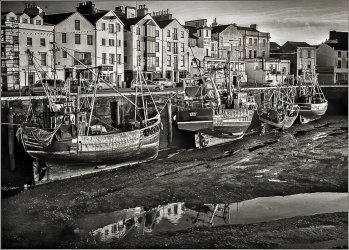
Ramsey copy.jpg
 
Who pulled the plug out?

CT137 is a fine old wooden hulled fishing boat, I don't imagine there are that many of those still earning a living. Is that a steam-funnel, or am I entreing into the realms of fantasy?
 
Hope you are feeling better.

Can't fault the composition and I like the reflection in the remaining water. Nicely observed.

Nit if you want: There is quite a lot of contouring in the clouds and there are some white lines on the rooftops. Perhaps a tad overcooked on contrast and sharpening?

@Toby Webster Stock photo can be found here without a funnel. Difficult to tell but I think it's a mooring post or a feature in the dock wall.

 
Last edited:
Agree with Glenn, lovely scene and composition but the image does look a bit strange. Maybe it is just down to the strong cross lighting.
 
We still have a few of of wooden built vessels like these these that land fish up and down the NE Coast between Eyemouth and Whitby. Gone are the deep sea steam driven trawlers that used to go out for 10-12 days at a time up into the seas around Iceland. Remember the 'Cod Wars'? At one time there were 15 or so at North Shields on the Tyne or so but not all at home at once because the quayside could not take them all. There was always a bit of a 'pong' around them in the summer that drifted up into the town if there was a southerly wind
The fleet is so emasculated now I doubt if there are 15 of these small inshore boats in total. The big Russian factory ships and the EU fishing bans ended that and it is only now still recovering.
 
Thanks all for the comments. Hellen I think you have it right. It's very Golden Hour lighting and it was quite difficult to process. I keep telling myself that I should take a second mono jpeg in situations like this but I generally forget.

Sadly, I think it was EU quotas that did for many of these boats. I remember reading of skippers taking a chain saw to their hulls and the regret that was expressed at the time as much as for the fact that the sort timber needed to build vessels like these is now so hard to come by as for the loss to the fleet. I grew up in Blackpool and I can still remember that when the fleet docked in Fleetwood and the wind was from the north, you could smell the fish right down to South Shore where we lived. Now apparently, there is only one fishing boat registered in Fleetwood although others do dock there from time to time.
 
John it wasn't EU quotas that did for the UK fishing industry. It is simply because of over fishing for more than a century, the fish stocks couldn't support the fleet. Countries like Iceland, extending their territorial limits and denying access to their waters was another problem. The EU did have an impact at the end I agree, but it was the final nail in what was already a very nearly completed coffin. The UK's own fishing industry destroyed almost by itself, the vast Herring shoals in the North sea and wiped out the Cod fishery on the Grand Banks in the Fifties. Neither has ever really recovered after more than 70 years and now huge factory ships are doing the same to the Mackerel shoals. It seems we never learn.

This article from the investors Chronicle, which is non partisan, outlines the story of what happened to the British fishing industry, if anyone is interested.


Sadly, it also shows that world wide, commercial fishing is still over exploiting the Worlds' fishing resources to this very day, just like business is over exploiting every other resource on the planet in the rush for profit.

I would just say that these comments are made by me as an Angler and someone who has a keen interest in the natural world and environmental issues.
 
I take on some of what you said but in the main in the 50's 60's and some of the 70's it was the comparatively huge factory ships from Russia and Poland that caused the most damage. They were massive 6,000 to 10,000 ton vessels with fish processing plants on board. They stayed at sea for up to a month and more, gathering up all they could find and not heeding how small some of the fish were, so not allowing them to mature to enable them to reproduce.

Not only did they use nets with a small mesh, they did literally 'hoover' up from the bottom of the north sea which in places like the Dogger Bank is less than 30 feet deep. That alone caused immense damage to the breeding grounds.

Growing up, living and later working in the local police force which had the Fish Quay under its responsibility we heard and saw that the atmosphere was frequently outwardly hostile to the foreign vessels and crews that often came into the Tyne to stock up with food for the mother-ships.

On a number occasions they were denied moorings and sent away empty handed to get victuals elsewhere. The local suppliers either refused to supply them or were picketed to stop them being re-stocked.

When you think of the size of one of our deep sea trawlers was around 500-700 tons, a 6,000 to 10,000 ton vessel simply dwarfed our home fleet. They did not come into the Tyne, that would have cost them dearly in money terms to pay for the river pilot, so sent smaller supply boats about the size of the vessels in the pictures at the start of this topic to collect what they needed.
 
Thats true as well but they weren't in the EU at the time. The irony is we invented factory fishing to exploit the Grand Banks and other countries thought what a good idea. I understand that some of the very large boats slaughtering the Mackerel stocks are based in Scotland.

But my comments are an overview and the overfishing by our own boats before the 1950s led to the start of the collapse in UK fish stocks. At that time we were also sailing far a field taking other countries fish, that is why we were still able to maintain a big fleet of fishing boats when our own stocks were collapsing.

The article referred to previously explains what happened in much more detail than is appropriate on this forum. I just thought it might be of interest.
 
Back
Top