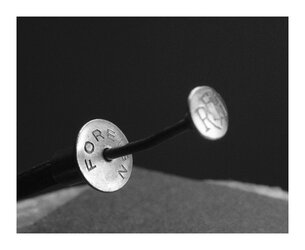
Pentax Spotmatic Close-Up Study 1

ian barber

Admin
Registered
A while ago, I acquired a 28mm M42 mount extension tube (unknown make) but never really thought about using it, so I decided to try it mainly just to see if the image quality suffered by using the tube.

The film used was 35mm FomaPan 200 (ISO 100)
The developer used was Kodak D23 (stock for 71/2 minutes 20°C

Pentax With 28mm Extension Tube.JPG
Exposure Adjustment
Now the tube is added, this has moved the lens 28mm further away so in theory more exposure will be required to compensate for the light loss through the extension tub, the question I was faced with was, just how much extra exposure is required.

Quick and dirty calculation
The lens I used is 58mm and the tube is 28mm so I figured the focal length is now 86mm
Without using all the EF/FL calculations, I tried to break it down into simple terms by thinking in f/stops.

58mm lens = f/5.8 (let's call it f/5.6 as we are used to that figure)
58mm lens + 28mm Tube = 86mm (let's call it f/8 as we are used to that figure)

Difference between f/5.6 and f/8 = 1 stop ( so let's give it one extra stop over and above what the light meter says)

Lighting
For all still life I use an LED 5600k dimmable panel. Does film react differently when used with LED lighting?, I don't know, I haven't done any testing and that's another rabbit hole I have to go down at some stage.

Metering
All metering was done using incident metering, with 1/2 the dome catching the LED light and 1/2 the dome catching the shadow area.

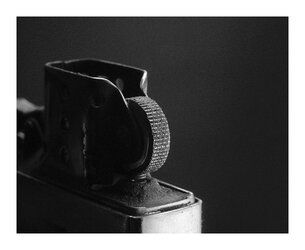
Pentax-Spotmatic-Closeup-Frame1.jpg

Pentax-Spotmatic-Closeup-Frame2.jpg

Pentax-Spotmatic-Closeup-Frame3.jpg

Pentax-Spotmatic-Closeup-Frame4.jpg
 
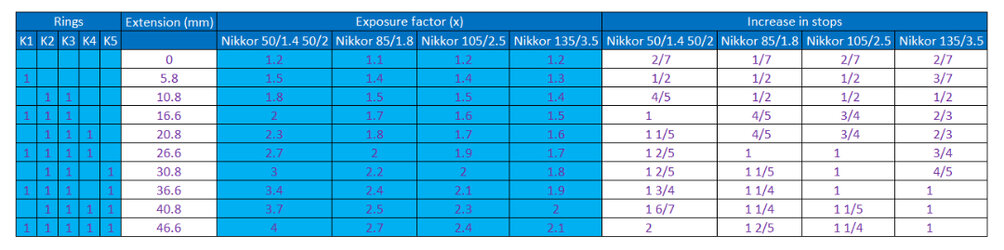
The table for my model K Nikon extension tubes for use with a Nikon F says:

Exposure factor for K1+K2+K3+K4 (5.8+5.0+5.8+10.0 = 26.6mm) extension with a 50 mm. f/1.4 or f/1.2 lens is 2.7x.

Exposure factor 2.78x = 1.5 stops.

So overexposing by a stop is definitely in the right ball park.
 
Exposure factor for K1+K2+K3+K4 (5.8+5.0+5.8+10.0 = 26.6mm) extension with a 50 mm. f/1.4 or f/1.2 lens is 2.7x.

Exposure factor 2.78x = 1.5 stops.

So overexposing by a stop is definitely in the right ball park.

Not far off then, I could increase by an extra 1/2 stop to see if I can see any difference but with bw film probably very little.

I think I might look out for some smaller ones, 28mm is quite deep for 35mm
 
The tables in the IB show that the difference between a 50 mm. lens and an 85 mm lens at 26.6 mm. is 0.4 stop so the difference between a 50 mm. and a 58mm. lens shouldn't be significant. There is no difference between 26.6 and 30 mm. extensions so either should work for 28 mm.

The calculations are made with the lens at closest focus setting which is why, I think, there is a compensation value published for zero extension.
 
Last edited:
Ian, I hope that I am not treading on slippery ground, it has long been known that a camera lens used with tubes or a bellows extension is usually best used reversed, so that the front element faces the film plane. I used to have a 42mm adapter the the camera mount thread on one side and a 49mm filter thread and yes that is what I found. The exposure was never calculated but the camera stop down metering (Pentax SP) relied upon in conjunction with a grey card and it was usually correct or very close to it.

I also had another adapter made by SRG, then based in Watford with a 42mm camera thread on one side and a 39 mm on the other to take an first version of a Nikon 50mm/2.8 enlarging lens enlarging lens. There was no distinguishing difference between the quality/sharpness/contrast and that of a reversed 55mm/F2 Super Takumar when the test negs were printed.
 
Not something I am aware of, Please can you explain the reasons
Apart from reading various publications and practical experience myself there was a good article some rears ago which described how lenses made for normal photography were optimised to give their best performance a certain distance away from the camera. It varied according to manufacturer but I do recall reading that it was a distance from approximately equal to 200x the focal length of the lens to infinity and that was what they were designed to do. Apparently it was something involving the 'corrections' designed into the lens for working at a distance. For lenses designed primarily to work at close distances such as Macro and enlarger lenses the corrections were designed to accommodate the quite short distances involved.

Most of this information I seem to remember came from two books the Ilford Manual of Photography 1963 edition and an unknown Leica manual published just after the war (around 1949-50ish not by Leica but from an American Author).

As well as the Nikon lens I mentioned earlier, for several years I used a TTH 105mm F4 enlarging lens on a set of adapted Minolta bellows to give a close up/macro lens. I had a 39mm screw thread to Minolta bayonet mount made by the company SRB to fit it to the bellows. That set up allowed me to get an image almost twice life size with no drop of in quality except there was a certain lack of contrast which was apparent even when I used it as a an enlarging lens for 6x9 negs. (SRB is now trading as SRB Griturn, just google the name for their website. They are no longer in Watford.

This drop in contrast is what I found with lenses that were much older than the ones we can find today with complex corrections designed in using computer technology, but I have two purpose designed Macro lenses, both manufactured under the Tamron name. One is the 90mm/F3.5 Adaptall 11 design from the mid to late 1970's with a Minolta Mount and an ext tube to take the normal 1-2 macro ratio to a 1-1 ratio.
The other is a very up to date 90mm F2.8 with a 1-1 reproduction ratio. Higher contrast is obvious but the sharpness is little different. I included this to show how lenses have improved in the past 40+ years

But going back to the original question it was also suggested at the time that a standard camera lens reversed would make a very good enlarging lens. I knew someone who had a 50mm Tessar which was fitted with a 49mm filter thread adapter to a 39mm screw thread adapter to use as a wide aperture enlarging lens when the norm was F3.5 or even F4.5

Apparently it was something to do with eliminating the curvature image that a camera lens presented when used at close distances in the normal mode. As we all know the flatness of field is essential to getting a sharp images corner to corner with the back of the lens facing the film.
Of course, using a camera lens of a complex, multi element/group design could present other problems if used on an enlarger. The heat from the enlarging bulb could risk softening any balsam and seperate the elements!

I have just found this in a 2 minute search of the web (You tube) it probably will demonstrate what I have been writing about in a clearer way because it is on video.

 
Last edited:
Interesting, I am seeing that still life, minimalism and street photography creates images I find appealing. Landscape hasn't tickeld my fancy, yet.
 
Back
Top