Dynamic Range Experiment

Digital Finger

Well-Known Member
Registered
a VERY rough and ready look at dynamic range
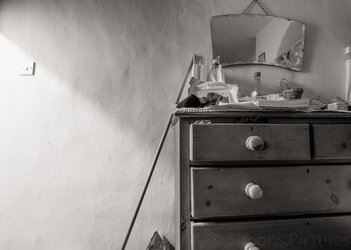
Ian suggested I photo a towel but all my towels are camera-shy so I went for a wall instead.


I have absolutely no idea what I'm doing so feel free to laugh your heads off

I bracketed an exposure (fortunately it didn't bracket me back!!) and present here for your delectation one shot at EV 0 (zero) and one at EV+4 , with 100% crops of the highlights and shadows. (not sure why one is more toned than the other but too tired to bother looking at the files (it's 2am)

I made all the normal adjustments in Lightroom for lift shows, add texture, lower the highlights etc that I might normally do (but rough and ready, not polished)

I noted there were 'blinkies' on the highlights on the camera LCD but no clipping in the highlights in the RAW file, even before any adjustments.

The highlights show differentiation between the brightest part of the wall (shown as just clipped on camera LCD for EV 0 (Zero) and as quite clipped on the EV +4 shot)) and the white lightswitch

The shadow shows hardly clipped inside drawers, texture and noise reasonable and decent detail ( still with room to pull out more)

What impressed me here ( and again feel free to bust a gut if I'm being completely daft) is that the brightest part on an EV0 exposure which showed clipping on the LCD was still well within recover even after increasing exposure by 4 stops , and that was room to spare.
EV0
_V8A6812.jpg

EV+4
_V8A6816.jpg
EV0
_V8A6812-2.jpg

EV+4
_V8A6816-2.jpg

EV0_V8A6812-3.jpg

EV+4
_V8A6816-3.jpg
 
(My turn to offer myself up for slaughter, but i try never to have any shame .....:))

On my tablet (on holiday at moment:)), the contents of each pair look pretty well identical.

Is that supposed to be the case?

To get across the points you want to make maybe you need to show accompanying histograms.

Btw, i think it is good that we are having these technical issues raised that are relevant to digital, to give a more balanced coverage of both film and digital topics:)
 
It would be informative to see this without the monochrome conversion. One of the problems I run into with blown highlights in digital is that, while I can recover detail, I can't recover color.
 
guys what this is supposed to show...is that the dynamic range is sufficient such that even at an exposure of plusfours-ooops I mean +4, over the mean (EV0) exposure, once adjustment are made in the RAW convertor, there is little discernible difference between the two exposures. The fact the the two images look the same demonstrates that despite very different exposures they can both be Brought together in RAW processing to look the same

I THINK what this shows is that I can pull back four stops of over exposure (which surprised me)
What I should also have done was a minus four (-4) exposure which sadly I am convinced would have shown very noticeable noise in the shadows.

As this was done a while ago now I can't remember exactly what my process was..

anyhoo...at least this shows that despite exposing at four stops over it is still possible to pull back the highlights. This is important for ETTR method because it suggests that you can ignore the blinks more than you think. However I wouldn't try it for the very bright sky as this tends to be in a race of more than 4 stoops frequently in difference between the brighter parts of an image and where the sn bleaches out the coins etc, the it can be hard to pull the blown bits back

need to do it again with a. Minus value I suppose.....
:(
 
Thank's for the investigation. Superior effort but I'm like Eilens can't tell the difference.

A couple weeks ago I over exposed a scene by two stops. Recovery isn't worth the time.
Perhaps we should get the exposure experts involved.
 
Assuming that we are considering digital does not the exposure depend on how the required measurements are made. For example, the camera is pointed at the objective and the shutter pressed or the camera is pointed at a grey card and those readings dialled into the camera. The chances are that these exposures may not be the same and, therefore, 4+/4- stops will be different.

Norman
 
I know I'm a pretty lousy photographer Simon but even I struggle to take shot that is four stops over exposed so I do wonder what you are trying to achieve. It is surely an accepted fact that by shooting RAW one has a certain degree of latitude with the exposure in post, and you have proved with your set-up a four stop latitude is still workable. Would it not be better to concentrate one's efforts on getting it right in camera rather than spend time working out an escape route? Just playing Devil's Advocate here. :D
 
I am not very bright but I have observed when doing my macro work that when I set the aperture and leave the camera to set the speed, if the background is black the camera will overexpose. Therefore, I will reduce the exposure by -2 or -3 to get a reasonable result.

Norman
 
I know I'm a pretty lousy photographer Simon but even I struggle to take shot that is four stops over exposed so I do wonder what you are trying to achieve. It is surely an accepted fact that by shooting RAW one has a certain degree of latitude with the exposure in post, and you have proved with your set-up a four stop latitude is still workable. Would it not be better to concentrate one's efforts on getting it right in camera rather than spend time working out an escape route? Just playing Devil's Advocate here. :D
I don't mean to speak for Simon, but I don't believe he's advocating for not getting it right in camera. He's merely pointing out what many of us already knew — there is some degree of latitude to over- or under-expose a digital image. There is a cost to be paid, certainly, but some light situations call for us to decide between noisy shadows or blown highlights. Simon was demonstrating empirically how the latter may not be as bad as some might have imagined, and that an "escape route" is available when needed.
 
Since everyone is offering themselves up for slaughter on this one, I might as well play the sacrificial lamb also :) It might be too simplistic to even mention but perhaps what Simon's experiment might show is that, in high contrast situations, it would be good to over expose by a few stops ( depending on your gear ) so that you can reduce noise in the shadows and still recover your highlights ??? I guess you might think of it as taking "shooting to the right" to extremes ?? I've read that it can be done because the camera meter yields a value that will set the scene to a 50% grey and , therefore, you will have some room or latitude to the right on the histogram in which you can increase exposure before highlights are actually lost. I believe the camera's metering to 50% grey is also the reason Norman get his over exposures with the black background ?? I believe a spot meter would do away with the need to compensate.
 
Since everyone is offering themselves up for slaughter on this one, I might as well play the sacrificial lamb also :) It might be too simplistic to even mention but perhaps what Simon's experiment might show is that, in high contrast situations, it would be good to over expose by a few stops ( depending on your gear ) so that you can reduce noise in the shadows and still recover your highlights ??? I guess you might think of it as taking "shooting to the right" to extremes ?? I've read that it can be done because the camera meter yields a value that will set the scene to a 50% grey and , therefore, you will have some room or latitude to the right on the histogram in which you can increase exposure before highlights are actually lost. I believe the camera's metering to 50% grey is also the reason Norman get his over exposures with the black background ?? I believe a spot meter would do away with the need to compensate.

Spot on Ron!:D

Of course the two examples look the same - that was the point of the exercise - to demonstrate precisely what Ron so eloquently put.
:)

what I could do next is try UNDER exposing by 4 stops but I know already what the result will be, i.e.e loads of noise.
ETTR (digital exposures only don't try tis with film ) means Exposing To Th Right
That means on your camera histogram you want to expose in such a way that the histogram is over to the right hand side BUT when you have strong highlights the histogram will get lines not just up TO the right but right UP the SIDE (going up towards the top).

That's called clipping i.e. if you produced a jpg out of camera areas would be pure white with no detail, and is normally a big NO NO>

However when shooting RAW there is more lattitude for retrieving information from the highly exposed areas and there is a reason to deliberately do this: there is more information in the highest exposures by a BIG factor than is in the lower exposed areas, so in te highly exposed areas you get more detail, more subtlety of tones and more texture etc and ....muxcch less noise.So the more you can get the histogram to the right the better RAW file you have except, if you have it too much to the right you lose ALL information and it's no good. So it's gamble most of the time, can you expose far enough to the right.. (i.e. slightly clipped on the histogram which is working from its own colourspace RGB or Adobe RGB which doesn't have the attitude of the RAW file) to get all the possible extra information into te file, without clipping it, or can't you?

This experiment was about finding out to what degree one can allow the histogram to apparently clip, yet still be able to get all the information from the RAW file without any clipping. It's a fine line and a gamble, but by experimenting we can better gauge the limits of our cameras latitude
 
Does your high dollar camera have more lattitude, with all those extra pixels, than my little cheapie, point and shoot? If it didn't it could probably fake it.

I love my little camera since I'm not too up to speed on the technical.. After all this is about photography, isn't it?
 
Does your high dollar camera have more lattitude, with all those extra pixels, than my little cheapie, point and shoot? If it didn't it could probably fake it.

I love my little camera since I'm not too up to speed on the technical.. After all this is about photography, isn't it?
Joe I don’t know the latitude exactly but it probably doesn’t have greater latitude, or if it does not by that much. What does make a big difference is shooting RAW versus jpg.
 
Back
Top