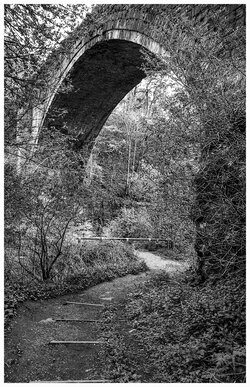
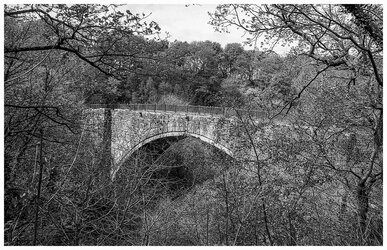
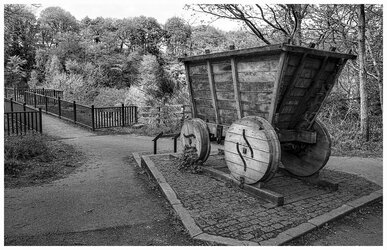
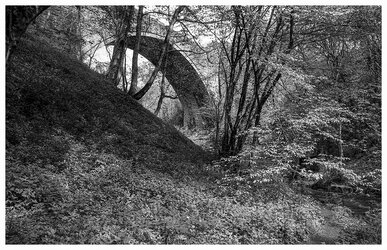
Causey Arch, County Durham

John King

Well-Known Member
Registered
Built in 1724/5 near Tanfield, Co Durham, by a local stonemason, Ralph Wood for the purpose of carrying a wooden horse drawn tramway over the Causey Gorge to take coal from Tanfield Colliery about 2 miles away down to the River Tyne for shipping to London. It is 80 feet above the Causey Burn below and from buttress to buttress, it very nearly 95 feet wide, and carried two tracks with a 3'6" gauge
At the time of building it was the widest single arch stone bridge in the world. Unlike previous stone arch bridges, including Roman ones this one did without a Keystone in the middle. The wagon was typical of the wagons hauled and would have a capacity of about 2.5 tons. To put the date of construction into context, it was 20 years before the 1745 Scottish rebellion. It is the oldest existing type of railway bridge anywhere in the world.
 

Attachments
  • 01.jpg
    01.jpg
    350.3 KB · Views: 22
  • 02.jpg
    02.jpg
    360.5 KB · Views: 22
  • 03.jpg
    03.jpg
    375.3 KB · Views: 21
  • 04.jpg
    04.jpg
    313.4 KB · Views: 22
Last edited:
Absolutely fascinating. I'd love to see more photos of this, in different light. I feel that there's more to give.
 
The first is best for me. Compositionally, it seems to me to work much the same as Helen's recent post Running Amok. The strong diagonal of the bank echoed in the top of the bridge, the messiness of the dark trunks and the foliage to the right, and the strong geometrical heaviness of the bridge. Sometimes a messy foreground is too confusing but in this case I think it works.

 
Last edited:
Thanks for the comments. This area is about 2 miles from where I live and close to Tanfield Railway where I volunteer so access for me is easy. The track over the bridge originally passed in front of the wagon and off to the right as you look at it. We, the volunteers have traced where it went from there and as it it the line's 300th anniversary in 2 years time there is a plan afoot to recreate a short length of the wooden track on the original track-bed.

That is not the only civil engineering masterpiece in the area. The burn below the bridge swings around to the right and originally flowed through another massive gap 300 feet wide and it would have been impossible at the time to cross that with a bridge. So they built a culvert about 150 feet long over the stream and infilled the gap above with whatever was available. (Probably waste stone and spoil from the pits) The embankment is actually a touch higher than the Causey Arch over the same burn. It is estimated that there was over 1.25million tons of infill needed. This was done without the assistance of any mechanical machinery, just horses, carts and pure hard manual labour. The culvert is still in perfect condition and supports the Tanfield railway that runs across the top. It is checked about twice a year by other Tanfield volunteers walking through.
 
Last edited:
Absolutely fascinating. I'd love to see more photos of this, in different light. I feel that there's more to give.
Toby, the culvert can be seen easily but not at this time of the year. the approach to the entrance will be very overgrown and prevent anyone from getting near. I will try later in the year when the vegetation has died off a bit.
 
Last edited:
Back
Top