Bit Of A Plant

Norman 1928 - 2018

Well-Known Member
Registered
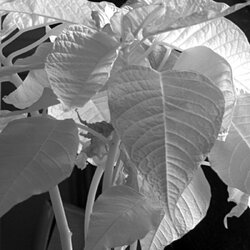
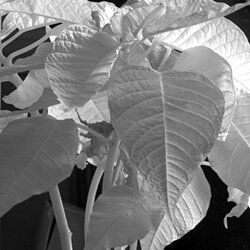
I decided it was about time to inflict upon you an example of what I have been occupying my time with recently. This is an extract of a photograph of a poinsettia taken with a Christmas present, a converted Panasonic Lumix G1 with a 640nm filter. The plant was standing on a table about a metre and half from the window and outside was a very dull overcast day, no other lighting was used. Very little PP has been done apart from adjusting the black and white point, correcting for a very slight blue cast, cropping and a little touch of contrast and sharpening. I am surprised at the luminosity or is it luminescence of some of the leaves and I'll let you decide which were green and which were red.

Norman

done.jpg done.jpg
 

Attachments

  • done.jpg
    done.jpg
    303 KB · Views: 0
I decided it was about time to inflict upon you an example of what I have been occupying my time with recently. This is an extract of a photograph of a poinsettia taken with a Christmas present, a converted Panasonic Lumix G1 with a 640nm filter. The plant was standing on a table about a metre and half from the window and outside was a very dull overcast day, no other lighting was used. Very little PP has been done apart from adjusting the black and white point, correcting for a very slight blue cast, cropping and a little touch of contrast and sharpening. I am surprised at the luminosity or is it luminescence of some of the leaves and I'll let you decide which were green and which were red.

Norman


View attachment 5256 View attachment 5256
Rather lovely
 
Was it a hand held shot? Even with sharpening it isn't obviously sharp as it could (should) be and some of the finer detail is almost certainly lost. I may be wrong of course, so can you say what size the actual image is in the larger picture? If I used my D300s and made a print like this anywhere around A4 size it would be pin sharp. Has the point of focus shifted because when using an IR filter it does and this may not have been immediately obvious. Most prime lenses and a number of high end zoom lenses have a Infra Red mark where after focusing without the IR filter, you manually move the focus point to align with the IR indicator.
 
Thanks Simon.

John, thank you for your comments. You raise some very valid points to which I will pay attention. The camera was on a tripod and the shutter actuated by a cable release, the exposure time was about 1.5 seconds. This image is no more than 10% of the original image which was never intended to be published but was simply part of a learning exercise. At least, it might cause some discussion from which I hope to learn.

Norman
 
Glad to see you took the jump to IR, Norman. You're going to have a lot of fun with it.
 
Steven, I have spent quite some time getting to learn how to use the camera especially as some doubt was raised about about focussing. I am now satisfied that all the automatic items tried work as expected and also that there is so much Infra Red all about us that there is no need to wait for the sun to shine. Some time soon I intend to try macro photography using IR, which should be fun.

Norman
 
IR is always there as you say Norman, it looks best in Sunlight because anything which has a temperature gives off heat or infrared light, so, maybe with that in mind for indoor shots the warmer an object is the higher and more intense the IR is produced
 
I wish I could comment because yours are always so helpful. But, I know about as much about IR as I know about walking on the moon.
 
I wish I could comment because yours are always so helpful. But, I know about as much about IR as I know about walking on the moon.

The IR treatment of suitable subjects can be spectacularly different. Some people think they go too far off the line with brilliant white foliage reproductions and black sky's. But then each to their own.

In the days of the true IR film made by Kodak, sometimes I would use a deep orange filter rather than the proper IR opaque red type, the results were far more subtle, but different to an orange filter used with ordinary film.
 
I think that there are two sources from which the camera sees IR, there is IR emitted by hot objects and there is reflected IR. For example, take a hot filament electric bulb, switch on and take a photograph. The camera will see the hot filament because of the emitted IR. Now point the camera at a green leaf, for example, at which the lamp is pointing and the leaf will appear white which surely must be due to reflected IR, or am I off my rocker?

Norman
 
Yes you are correct, light is energy, reflected from it in different wave lengths, some we can see others we cannot without using special films and filters, the wave length can go that high that we can see at night with special night vision goggles.
 
IR is always there as you say Norman, it looks best in Sunlight because anything which has a temperature gives off heat or infrared light, so, maybe with that in mind for indoor shots the warmer an object is the higher and more intense the IR is produced
The only advantage I can imagine of strong light over not so strong is a reduction in the exposure needed. Have you ever tried taking a landscape on an overcast day or in the winter using IR?

Norman
 
Yes I have, the image lowers in contrast which in turn does not produce the brilliant foliage which is often associated with IR , basically they don’t look as good. In winter as long as we have the Sun out we have reflected heat/light so no problem at that time of year.
 
It looks like it's sat in sunshine Norman. I can see that effect being useful on occasion as well as making interesting images in it own right.
 
I only wish I were able to get out and try however, I can still potter around indoors and test out different light sources.

Norman
 
The IR treatment of suitable subjects can be spectacularly different. Some people think they go too far off the line with brilliant white foliage reproductions and black sky's. But then each to their own.

In the days of the true IR film made by Kodak, sometimes I would use a deep orange filter rather than the proper IR opaque red type, the results were far more subtle, but different to an orange filter used with ordinary film.

Thanks, John.

IR always looks "otherworldly" to me. Which of course, is or can be a valuable element of communication by visual means. I'll keep watching and learning. Thanks, again.
 
Back
Top