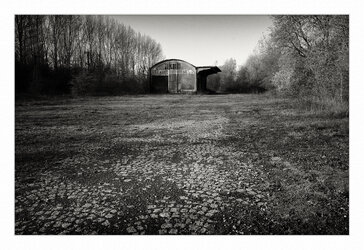
Beaucourt Station

Toby Webster

Well-Known Member
Registered
DSC_8941_1024.jpg
The goods shed at Beaucourt Station, Somme, rebuilt in the 1930s, now lying derelict. The station served as a focal point in The Battle of the Ancre of 13th November 1916 by the Royal Naval Division, the survivors of the Hood and Anson battalions, which had been decimated in the early stages, being rallied here by the extraordinary Lt Colonel Bernard Freyberg before successfully assaulting the German defences on the edge of the village. Freyberg won the VC for his efforts here, and was seriously wounded, one of 9 wounds received in WW1. He went on to command British & New Zealand forces in Greece and Crete during WW2, and the New Zealanders at Alamein and Monte Cassino. After the second war he served as Governor-General of New Zealand for some years.

So much for the potted history. I am not that thrilled with the photograph - in my efforts to include the beautiful cobble setts in the foreground I have placed the building rather centrally. Can I get away with it, is it one for a retake?
 
Last edited:
As the station was the focal point in the action so it must be the focal point in your picture and I am not sure that it is. The cobble setts are perhaps worth a study on their own with the station in the background and then another picture with emphasis reversed.

I don't think I have explained myself very well but I suggest you have a rethink.

Norman
 
I like what you've got here, the subject matter would appeal to me if I got the chance. I do think you've concentrated too much on the cobbles without showing enough of the building. Did you take any from the same location but using the long end of your 17-55mm?
 
Thank you Norman & Mark. I do have a few more takes on this scene, I will look back at them later.

I kept the building quite 'small' in the frame because it is an illustration of the 'landscape scene' of the action, rather than the building per se, which wasn't actually there at the time. It is, however, very typical of the post-war reconstruction, and conveys a strong sense of the period. There is also some feeling of desolation and remoteness in the empty surroundings that I wanted to convey.
 
I think you have done a splendid job here Toby. Like the other images you have taken of these areas it's more about trying to convey the atmosphere of the scene rather than specific items and my only point would be that it may require to be a touch more sombre - but that's a personal thing of course.
 
To make it more "pictorial" I would use a bit of Photoshop or Silver Efex to make the scene grainier or grittier, and perhaps use dodging and burning to lead the eye from the cobbles to the station
 
Thanks Keith & Trevor for the additional comments.

I could push up the contrast I guess Trevor, darken the areas on each side of the path. There is a certain gentle innocuity in the location though which I need to be careful not to lose.

I am finding that my photography in the Somme project has developed a certain 'quietness' which I am keen not to lose, because it does rather reflect something of the feel of the landscape here. But I take your point on board, and will have another look.

I like this , you have effectively rated the mood (or vibe as a term I prefer) - this questness is very easy to lose in editing, VERY easy, and in consideration that we edit for mood whenever possible we have to be very careful not to edit for technical convention over subtlety
I find it extremely hard to edit for que=ietness and this subtle feel so all the more do I appreciate your style Toby
 
Toby, I have re-read your original text about the site shown in your image. Do you think that the cobbled area could have acted as a sort of parade ground where the troops were assembled and from where they were galvanised into action by Lt Colonel Freyberg? If so, then perhaps the role of the building is not as important as I first thought and the history exists in those old, worn setts. The more I look at the photograph and try to remember those other photographs of yours in the Somme project the more I think you should leave it alone.

Norman
 
I agree with Trevor, a few extra tweeks would help to enhance it, maybe a bit of D&B on the cobbles to create , as you suggested, a sort of path to the building, and maybe some grain to give it that old film look, but in the end its what you want from it.


Tim
 
Will do Tim.

No parade ground Norman. The Hood Battalion lost half of its contingent to machine gun fire just crossing no-man's land, then advanced in confusion caused by appalling conditions for around a mile until the survivors reached this point, just in front of the German defenses ahead of Beaucourt village, which curved around the station. There were about 460 men left, of two battalions, sheltering in shell holes and rough trenches. The Germans were deeply entrenched, and well provided with deep dugouts. The whole area was devastated by the artillery fire of both sides. Freyberg was knocked down somewhere here. I think he was the only RND battalion commander left alive, the others had all been killed before reaching this far. All that you see here dates from the post-war reconstruction.
 
Ha! I can always guarantee that I can provide a cure for insomnia Norman. Just get me on topic, and you'll be away within minutes!
 
Back
Top